The full chronological story of CHSAA — from founding through today. Where we have deeper primary sources or newspaper milestones, follow the links. More founding documents live under Historical artifacts.
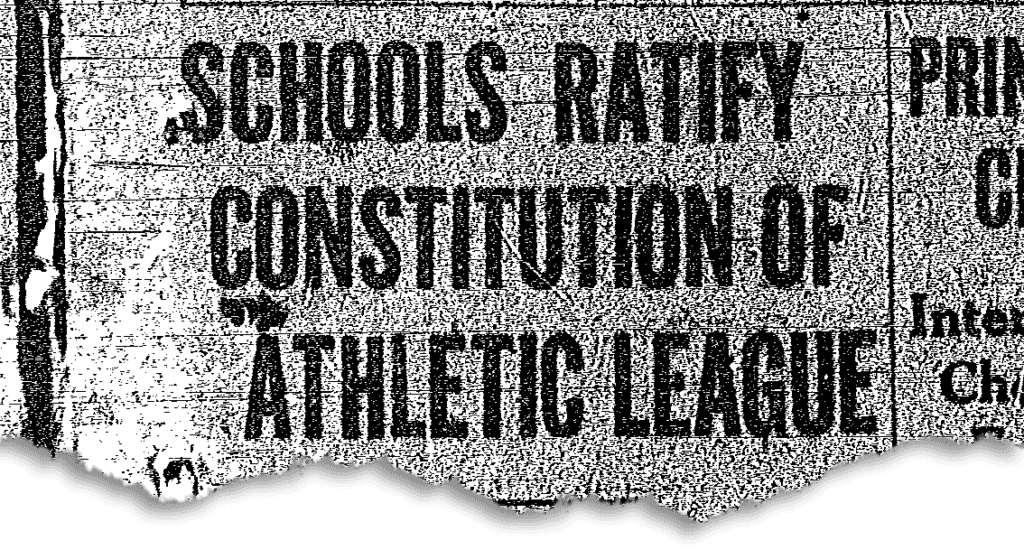
April 2, 1921
The Colorado High School Athletic Conference is founded, spawned out of a meeting at a teachers' conference.
May 1921
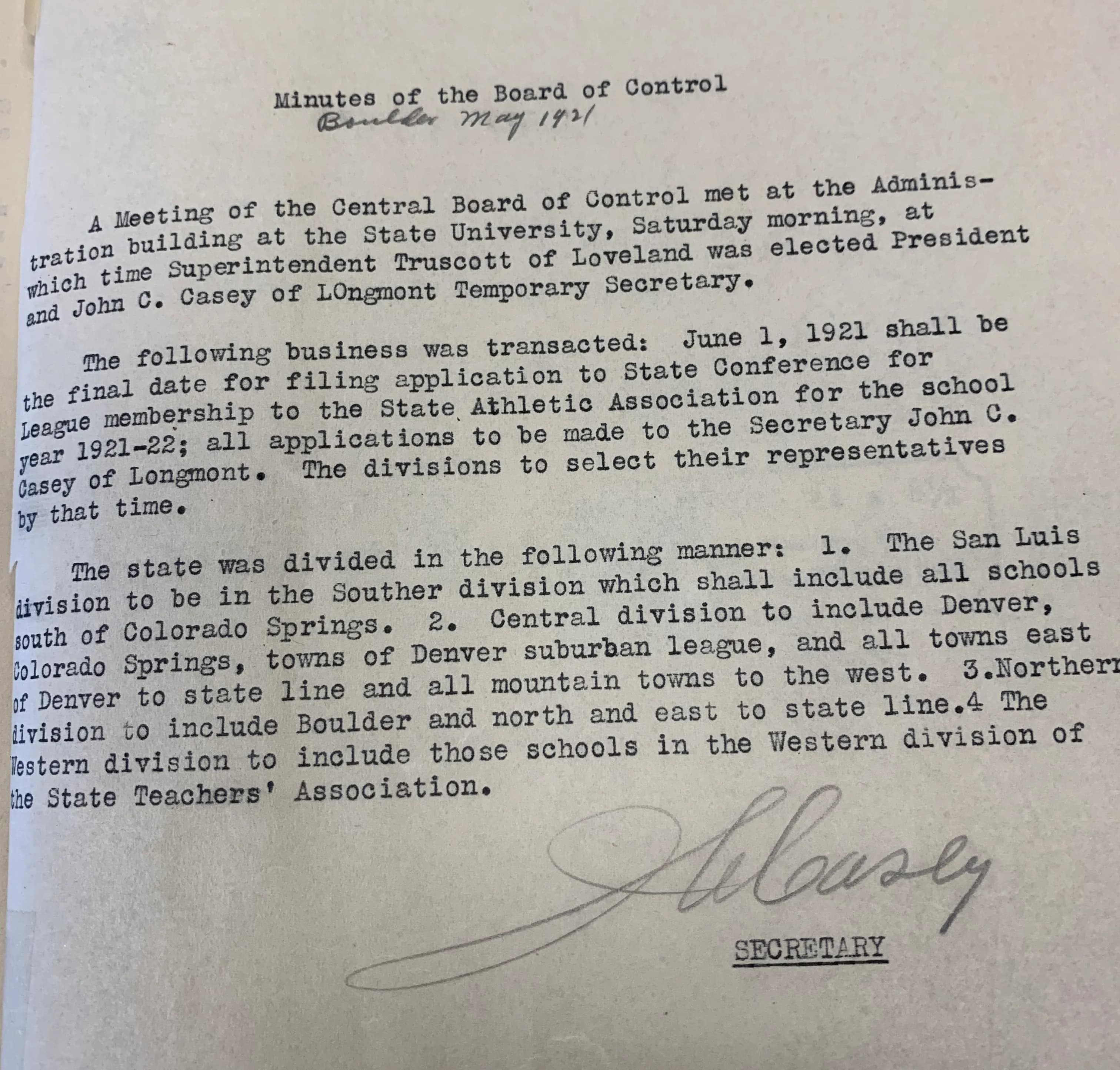
The state association holds its first-ever Board meeting, in Boulder. There are four regions, and nine leagues.
The first Secretary is John C. Casey, principal of Denver South HS, and the first President is R.W. Truscott, the superintendent of Loveland Public Schools.
There are three sports under the new association: football, basketball and baseball. Only boys sports are sanctioned.
The initial age rule limits participation to those under 21 years of age, though a student would be permitted to finish out the season they are playing if they turn 21 mid-season.
1921
Also in 1921, the Colorado State League of High School Girls Athletic Associations (known as the G.A.A.) is established. It aimed to promote competition for girls as "enjoyment of the sport and the development of good character" rather that pursuing sport for "making and breaking of records and winning of championships for the enjoyment of spectators or for the athletic reputation of institutions and organizations."
It is very specifically against interscholastic competition, a stance that CHSAC/CHSAA supports in the decades to come.
Fall 1921
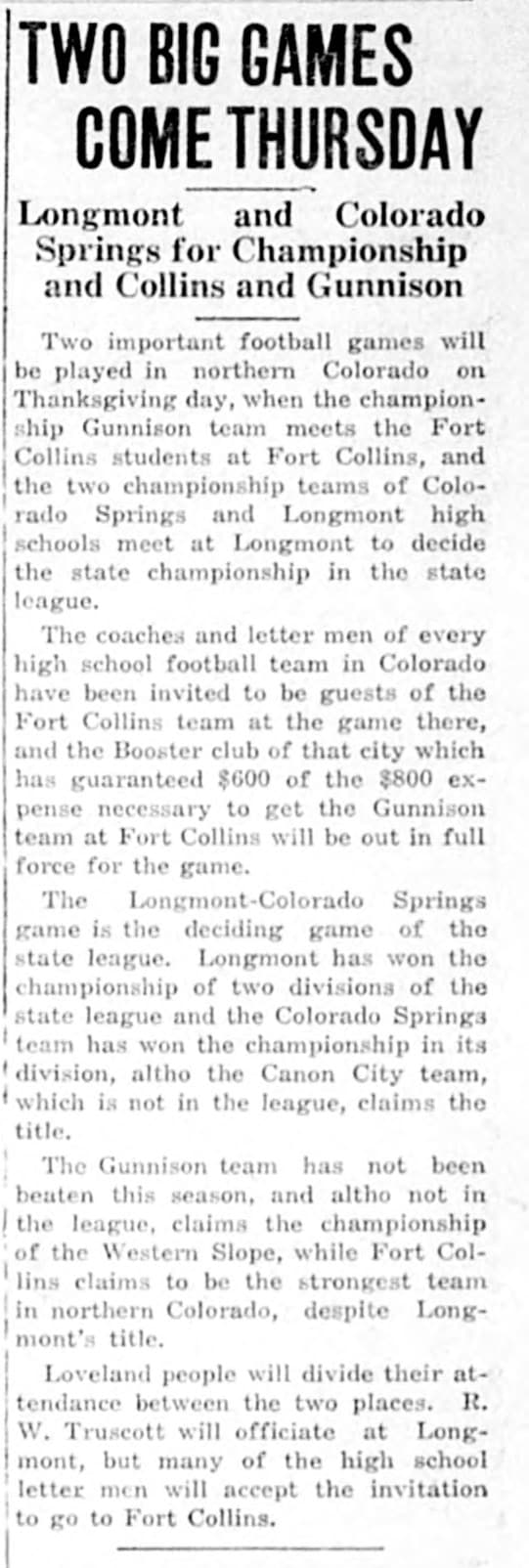
The first sanctioned season is held, and it's football which holds the first official championship. Colorado Springs wins the title — though not without some controversy.
Winter 1921-22
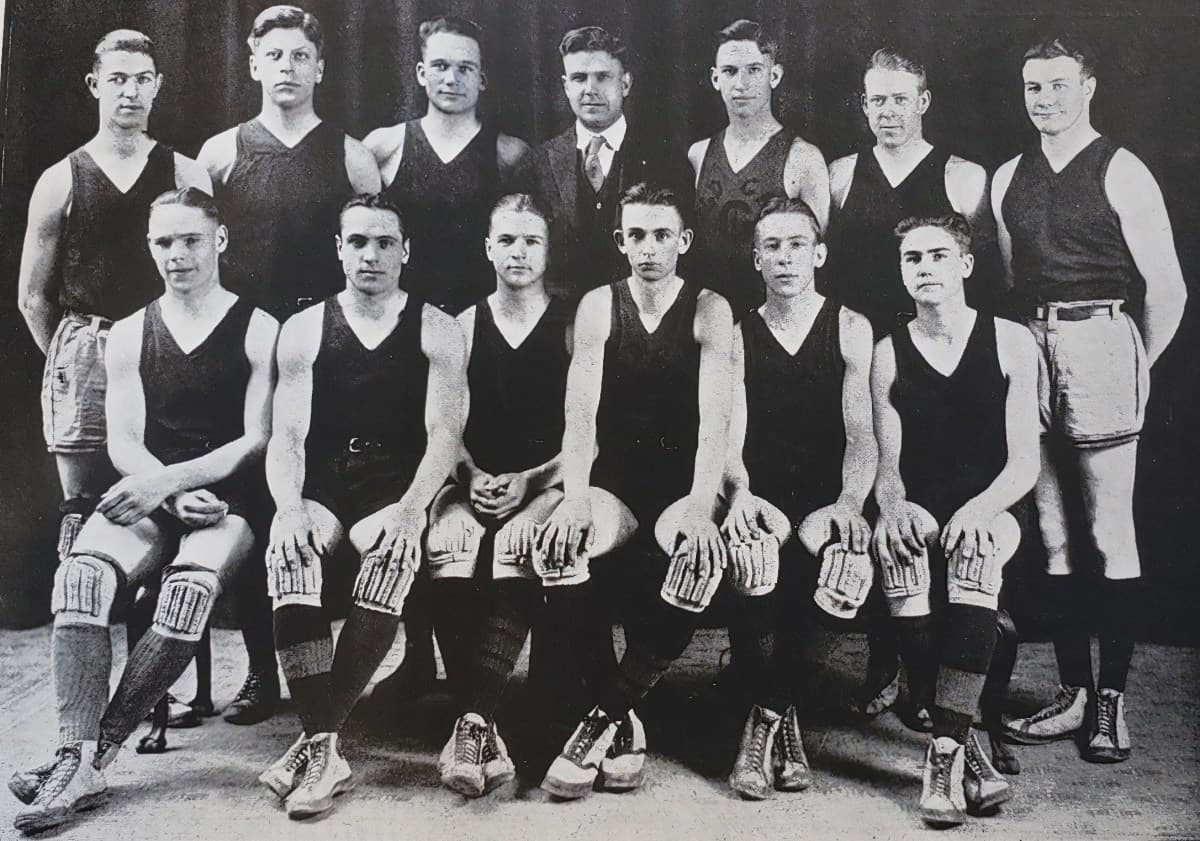
Basketball follows in the winter, and holds the first sanctioned tournament in that sport. Greeley wins, in a round-robin format.
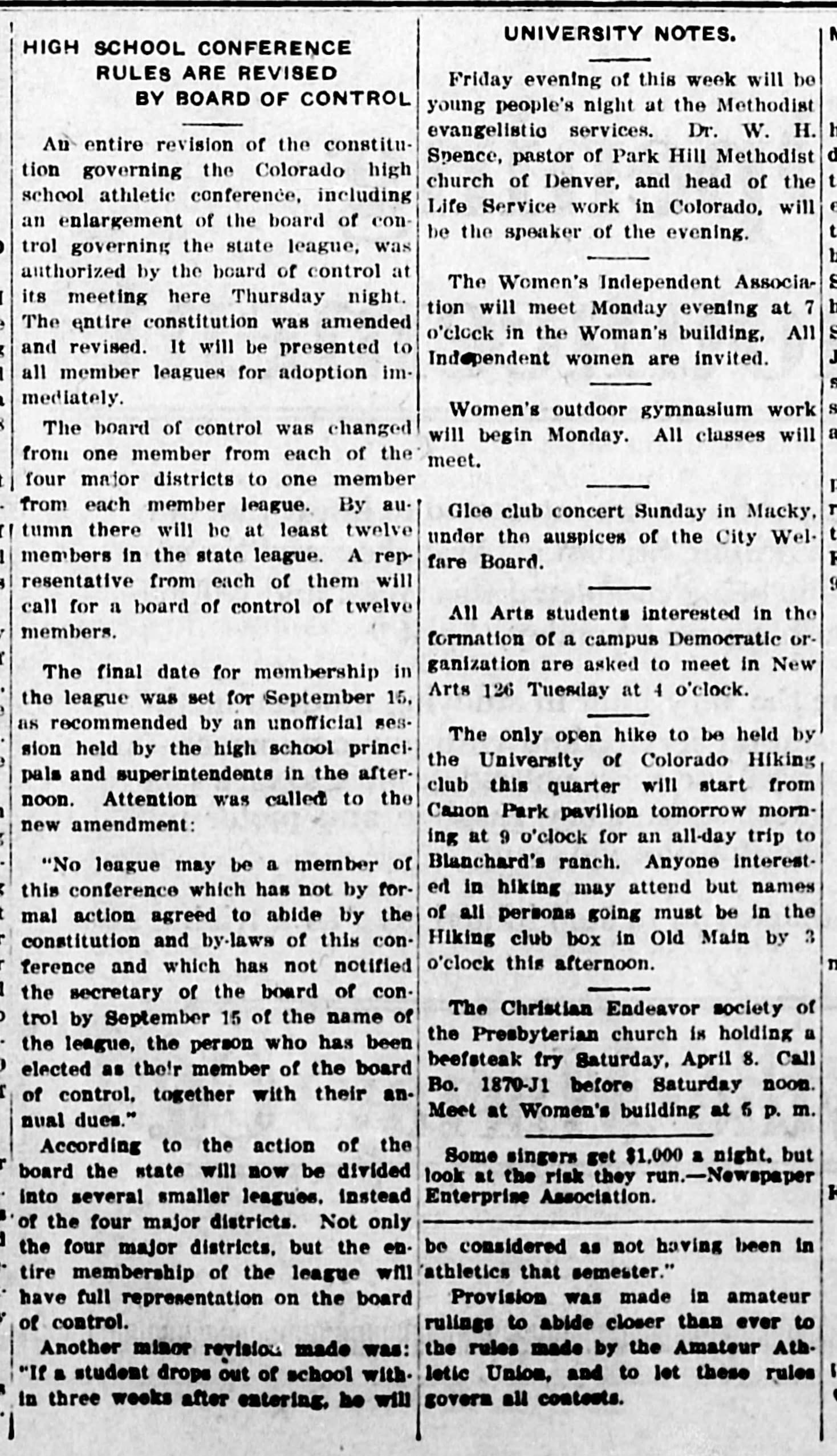
The board expands from four district seats to one seat per member league — the state league grows with its leagues.
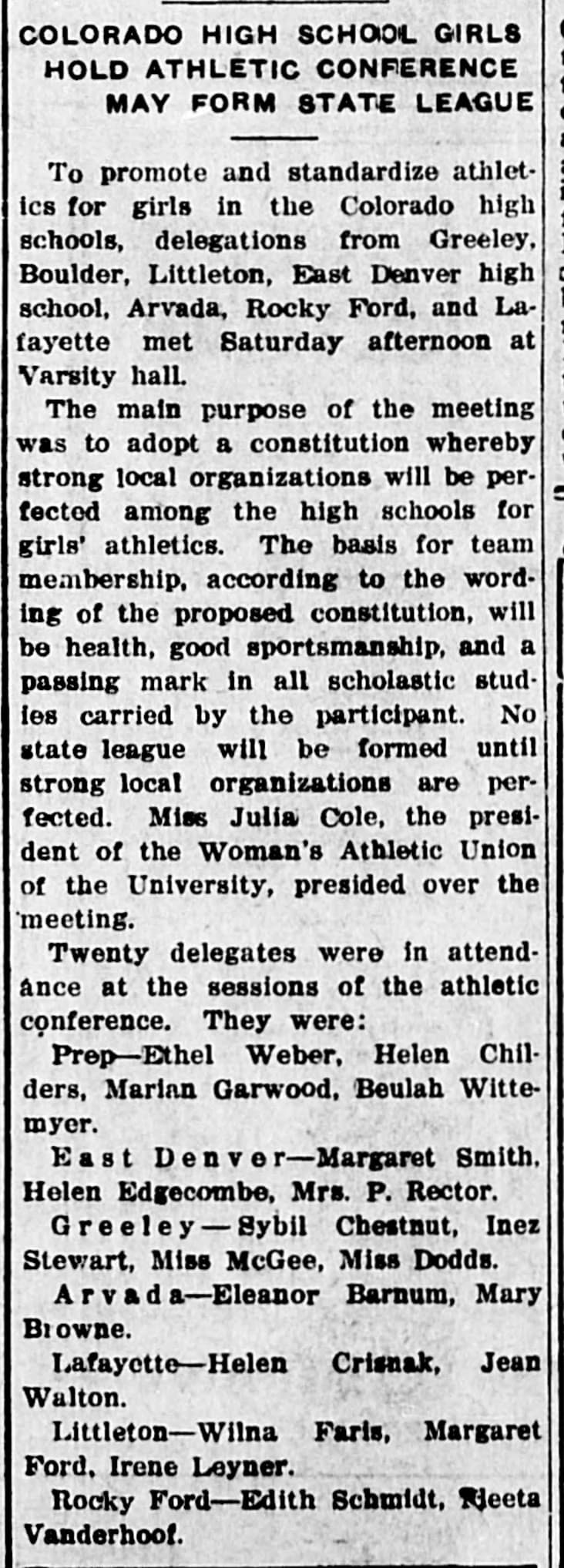
High school girls' athletic delegates meet in Boulder to draft a constitution and build local organizations.
Spring 1922
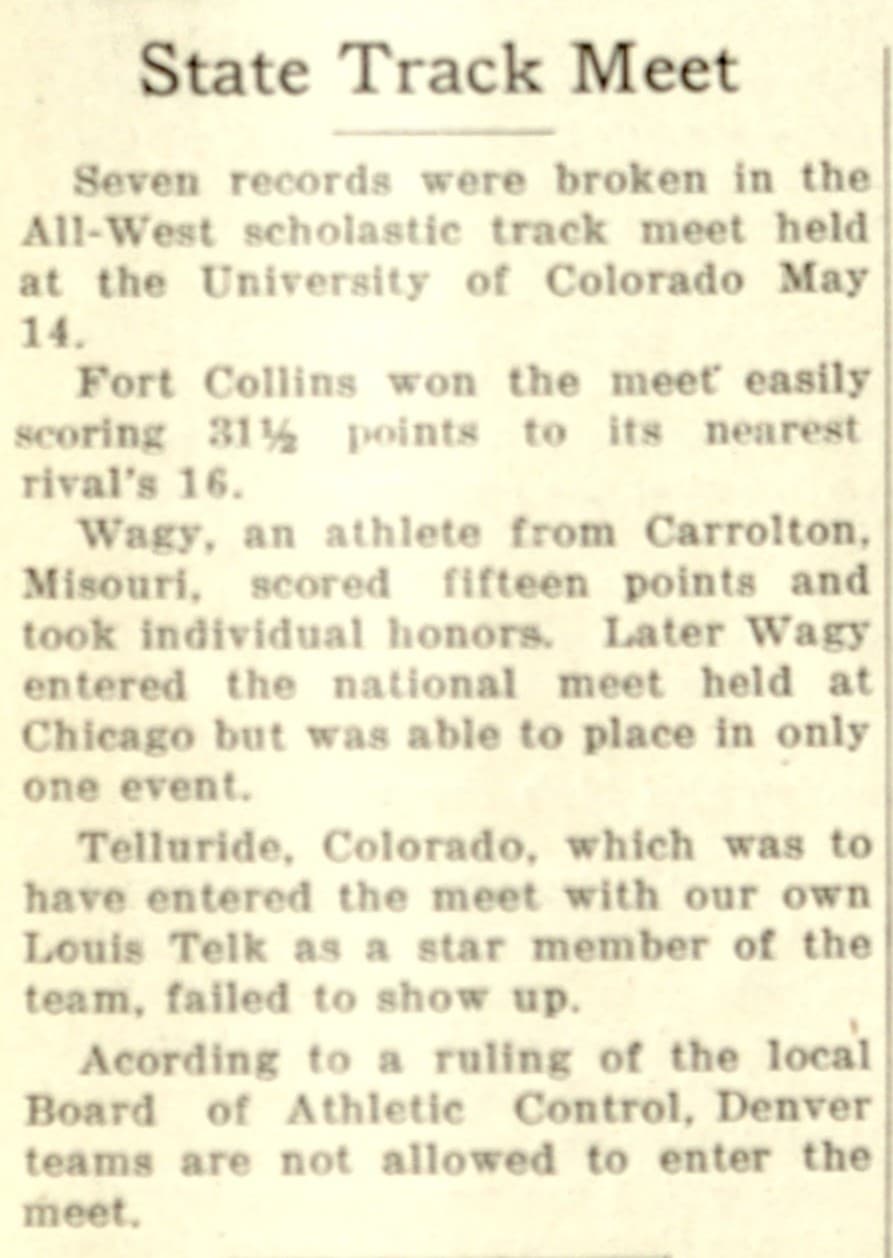
The first state track meet — often billed as the All-West or All-Western scholastic meet — is held at the University of Colorado in mid-May. Fort Collins wins with 31.5 points. Carrolton, Mo., sends a competitor, Wagy, who takes individual honors with 15 points. Papers report about 28 schools and roughly 240 athletes; Denver teams are barred from entering.
1923–1925
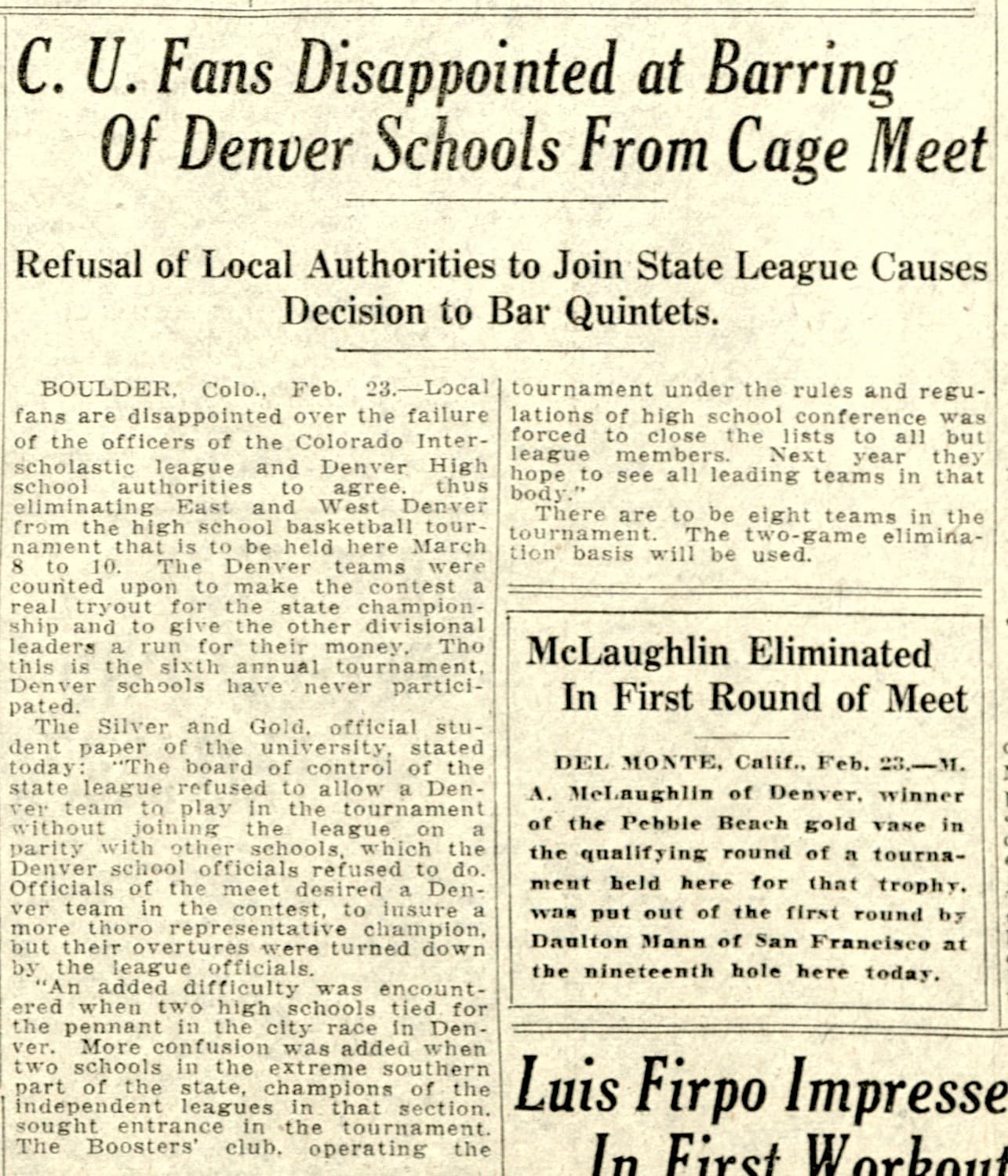
Denver teams are barred from state tournaments for staying outside the league — then move toward membership in 1925.
1923
For the first time, the state office determines playoff pairings and sets home sites — which are determined by "seniority membership of the league in the State Conference."

1924
CHSAA joins the National Federation of State High School Associations (NFHS). It has been an active member ever since.
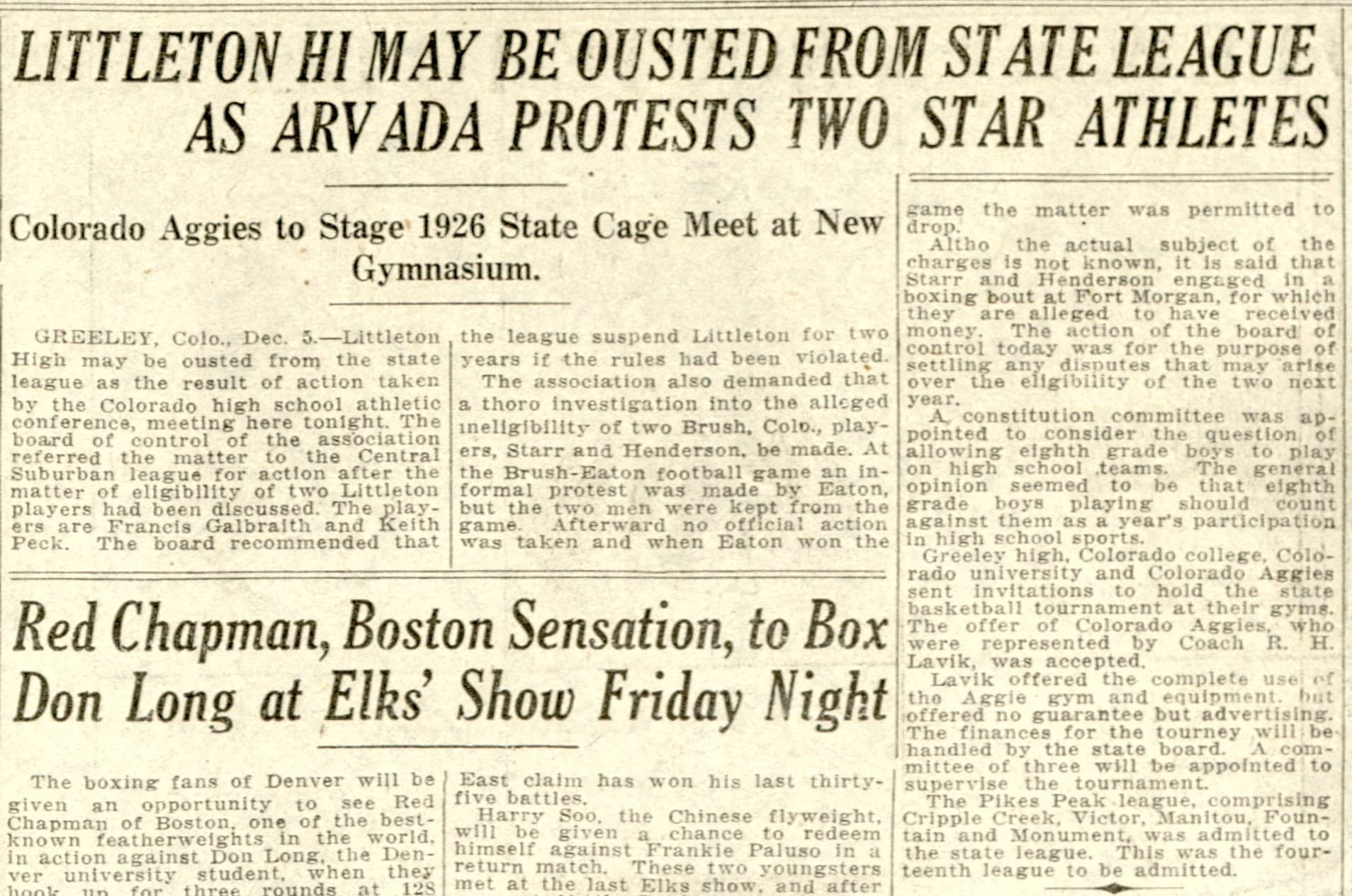
An Arvada protest puts Littleton at risk of being ousted from the state league over two athletes.
1925
The age rule is updated so that any student is ineligible to play once they turn 21.
November 1926
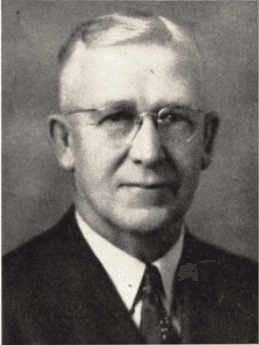
John C. Casey of Eaton — the Conference's first secretary — prepares to step down, effective December 4. The handoff clears the way for R. W. Truscott's long run as secretary and later commissioner.
Dec. 1926
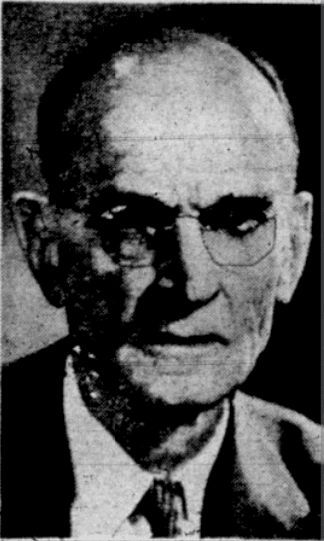
R.W. Truscott, who also officiated the first-ever football championship game, becomes Secretary, replacing John C. Casey. He will lead the Association for almost 22 years. He had a considerable impact upon high school activities in Colorado and around the country, having laid the foundation for the Association.
1927
The first transfer rule is adopted. It reads, in part, that "no student who is transferred from another school shall be eligible until he has been in attendance one semester unless his parents or legal guardians are bona fide residents of the school district to which he is transferred."
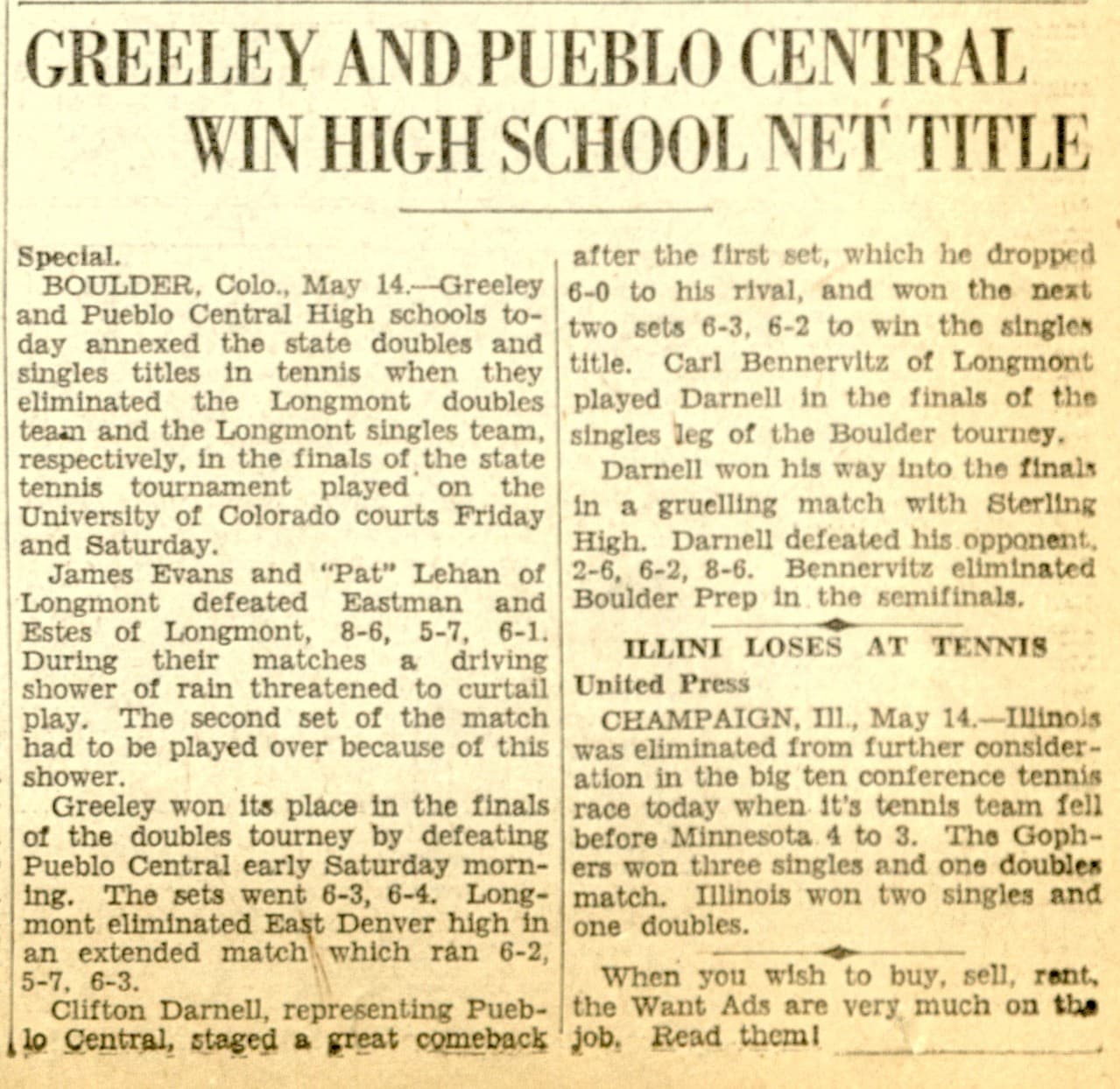
The first new sport outside of football, basketball and track is added with the sanctioning of boys tennis in 1927. At the state meet in Boulder, trophies go to the singles and doubles champions — not a school team title. Pueblo Central’s Clifton Darnell wins singles; Greeley’s James Evans and Pat Lehan win doubles.
Sept. 30, 1930
R.W. Truscott's title is changed from Secretary to Commissioner. This title has remained the same ever since.
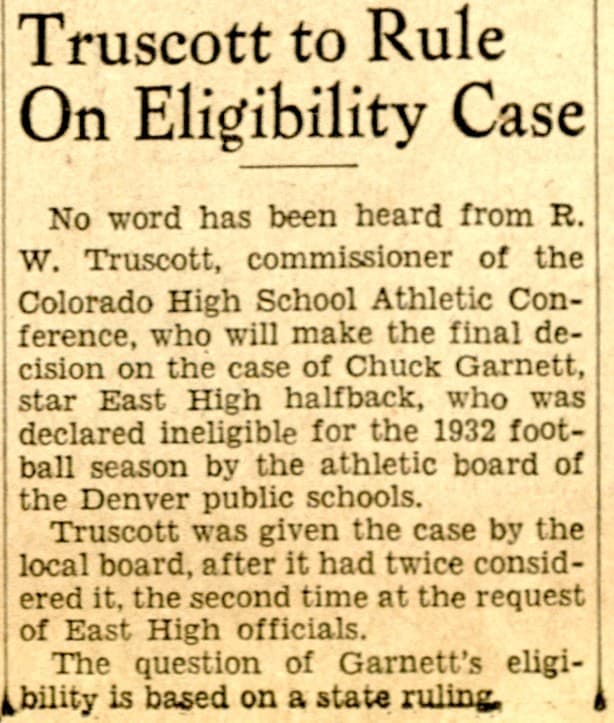
R. W. Truscott upholds East High's ban of Chuck Garnett — the commissioner as court of last resort.
1933
A wave of new bylaws are passed. Among them: Any contests played at night cannot be scheduled the day before a school day. An update to the transfer rule
1933
Schools are split into classifications for the first time: Large schools in Class A and small schools in Class B. Initially, this split is only in football. Boys basketball follows in 1938, and boys track in 1940.
1936
Wrestling becomes the first new sport in nine years. The inaugural state meet is held at Greeley over a Friday and Saturday in March 1936. Greeley High wins the team trophy with 32 points, ahead of Olathe (27), Fort Morgan (20), College High of Greeley (18), Grand Junction (9), Montrose (3), and Fort Collins, Golden, and Windsor (1 each). Coach Cecil Ackerman accepts the team trophy; gold, silver, and bronze medals go to the top three in each weight. Greeley and Olathe each take three individual titles; Grand Junction, Fort Morgan, and College High take one apiece.
1937–1938
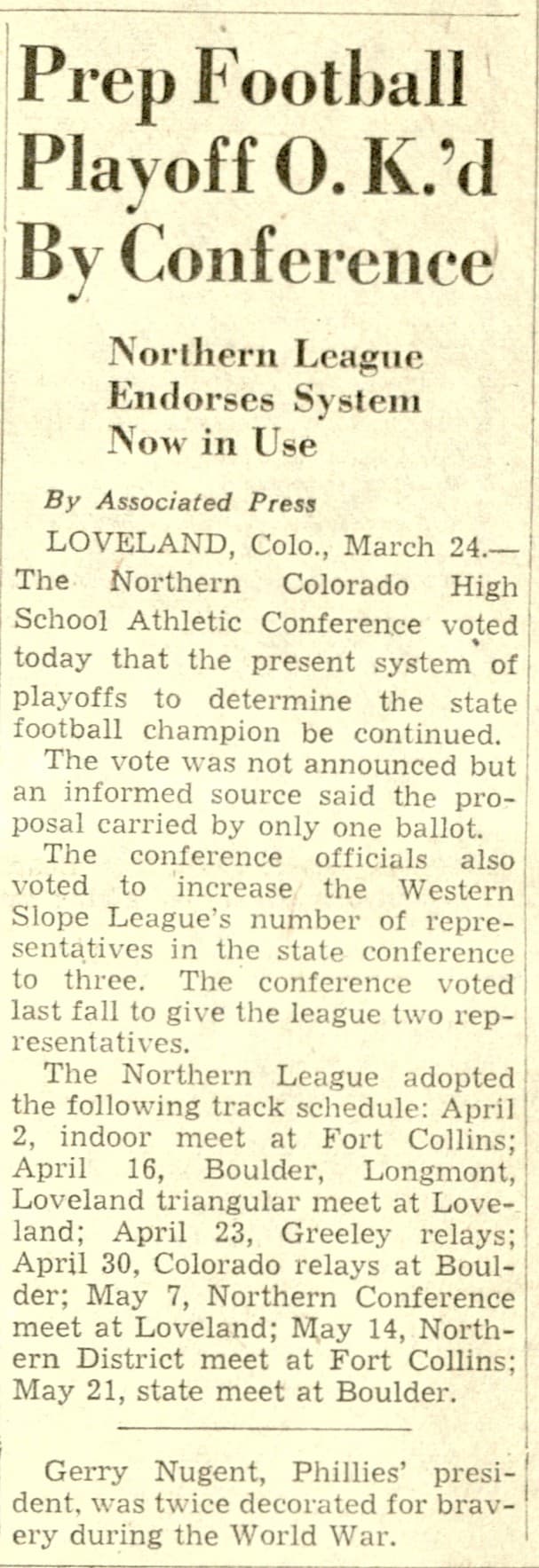
The title game is abandoned one year, then a conference playoff is approved the next.
1941
The age rule is given another update, and now students are ineligible to participate once they turn 20.
1943
The name of the association is changed to the Colorado High School Activities Association, so that all interscholastic activities are able to come under its administration and supervision.
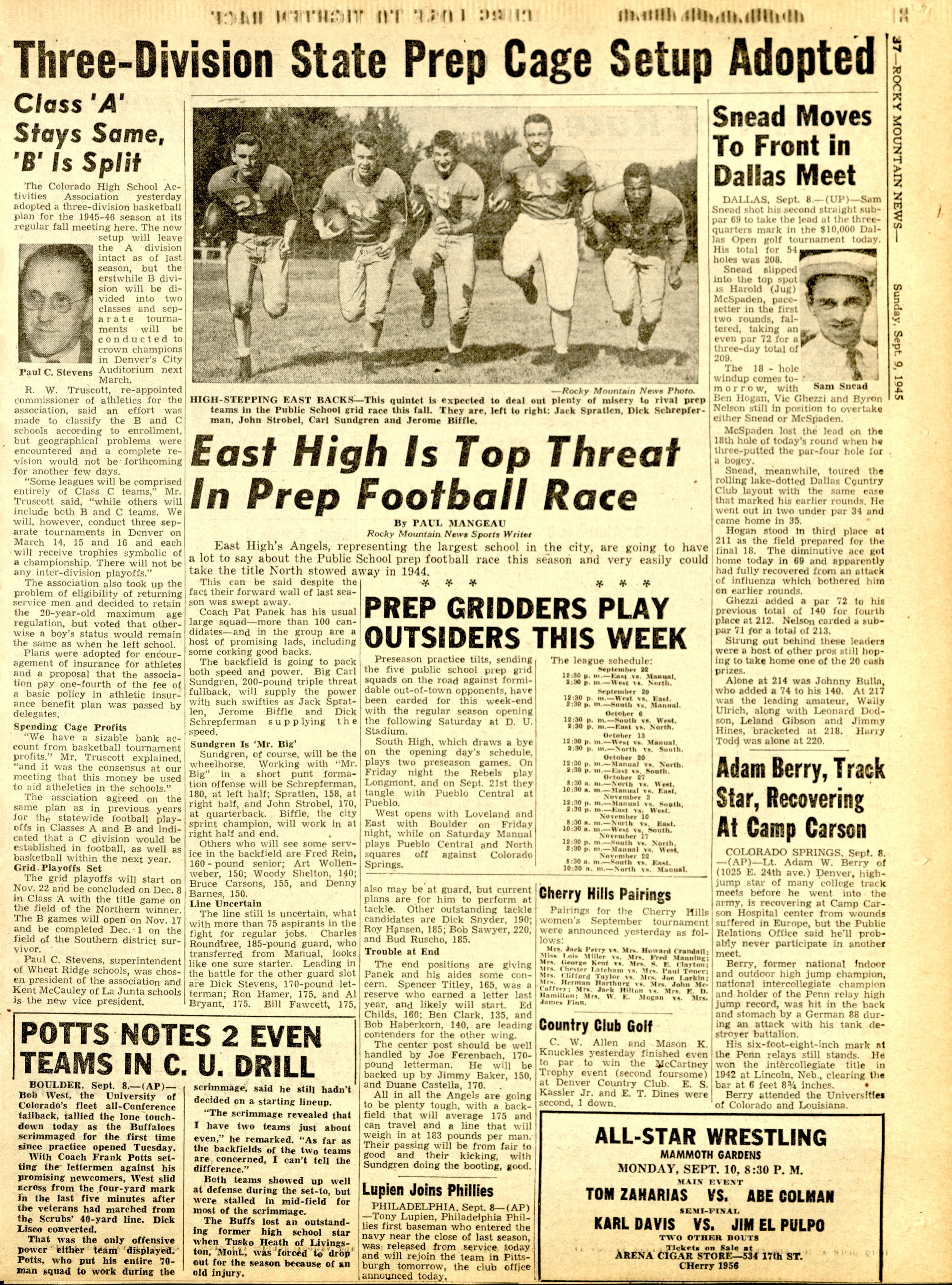
Under the new Activities Association name, Class C basketball and a three-division cage setup take shape.
1946
A new class is added for the largest schools, Class AA, in basketball and football. This gives those sport three classifications.
1947
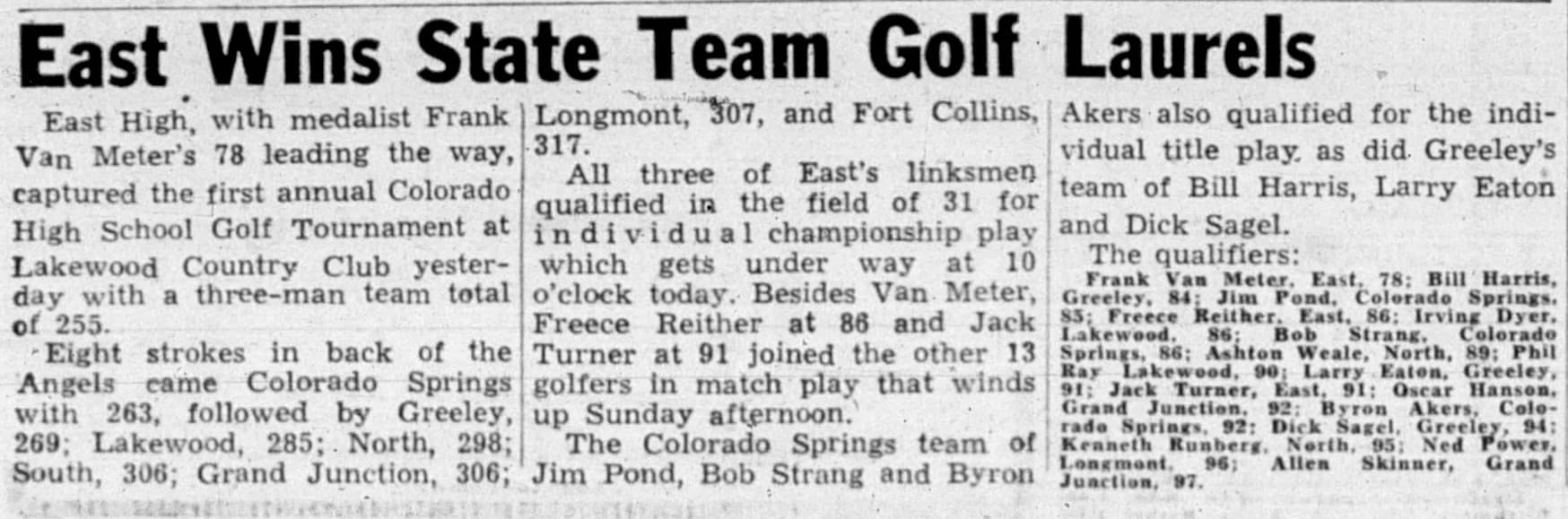
After 11 years, CHSAA adds another sport: boys golf. At the first annual Colorado High School Golf Tournament at Lakewood Country Club, Denver East wins the team title with 255. East’s Frank Van Meter is medalist with a 78.
1948
The Association moves into one room ("with a large closet") in a building owned by the Colorado Education Association (CEA) at 16th Avenue and Pennsylvania St. in Denver. Previously, it was housed at the Commissioner's school or district.
1948
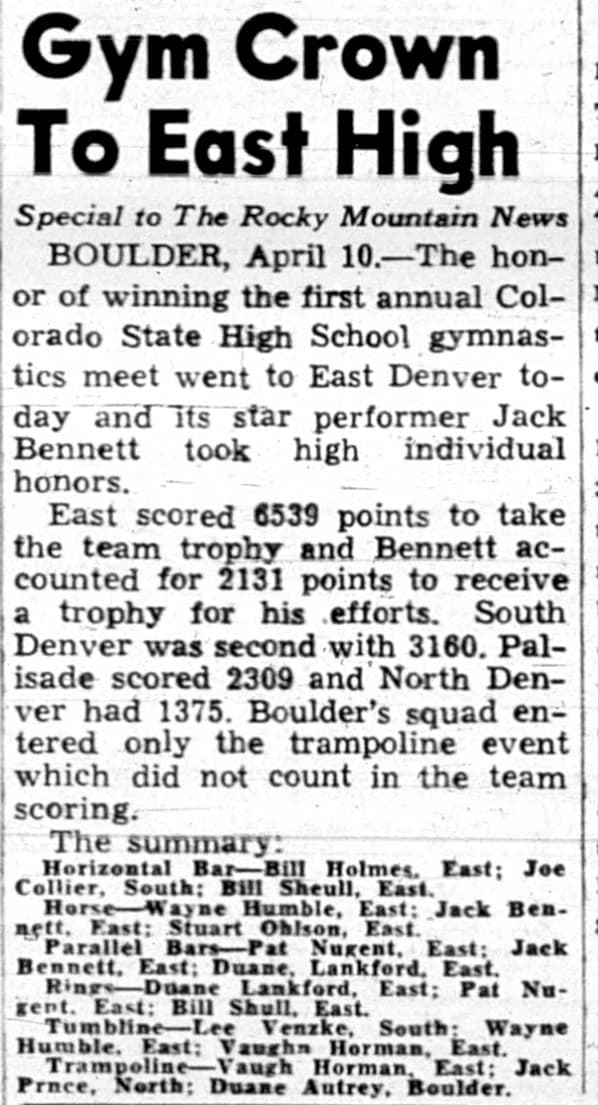
Boys gymnastics is sanctioned in 1948. At the first annual state meet in Boulder, Denver East wins the team trophy (6,539 points), well ahead of South Denver and Palisade. East’s Jack Bennett takes high individual honors. The Angels would go on to win 20 championships in the sport. Boys gymnastics is technically still sanctioned by CHSAA, but a championship is no longer offered. The final meet was held in 1991.
1948
6-man football begins with the addition of Class C. Football now has four classes. At this same time, boys track adds a third class, and now competes with Class AA, A and B-C.
July 1, 1948
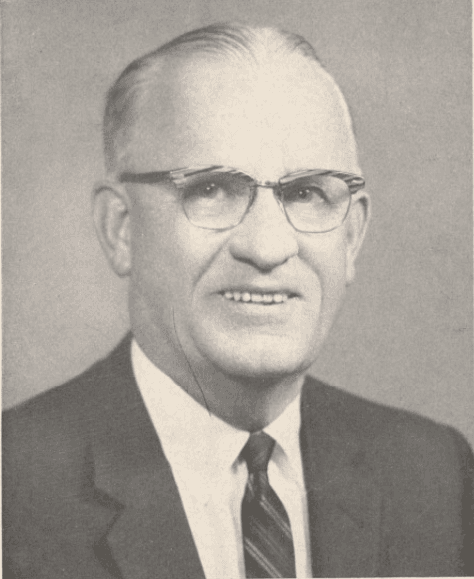
Glenn T. Wilson, a former superintendent in Fowler, La Junta and Greeley, is named the new Commissioner. A former Board president from 1936-45, Wilson is the first full-time Commissioner, and hires a secretary. He will serve for nearly 18 years.
Upon his death in 1973, Wilson was remembered as "the man who was perhaps the single strongest force in lifting the CHSAA to its present position of respect and prestige throughout the state."
1950
In another update to the age rule, a student is ineligible to participate once they turn 19. If they turn 19 mid-season, they are permitted to finish out the season.
1950
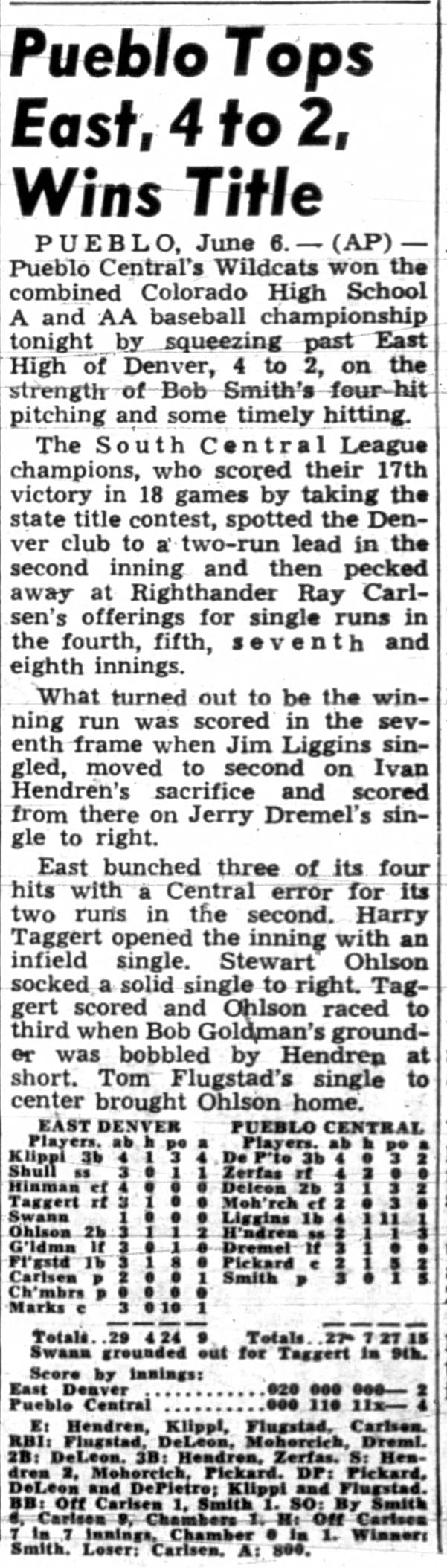
Though it had been played informally in schools for decades, baseball joins CHSAA as a sanctioned sport in 1950.
Pueblo Central defeats Denver East, 4–2, to win the combined Class A-AA title. Bob Smith throws a four-hitter for the Wildcats. Grover and Dove Creek tie in Class B, which doesn't hold a title game due to rain.
1950
Boys basketball adds a fourth class, and competes with Classes AA, A, B and C.
1951
CHSAA launches The Colorado InterScholastic, an in-house publication which details news of the Association, including reports on meetings and state championship results.
1951
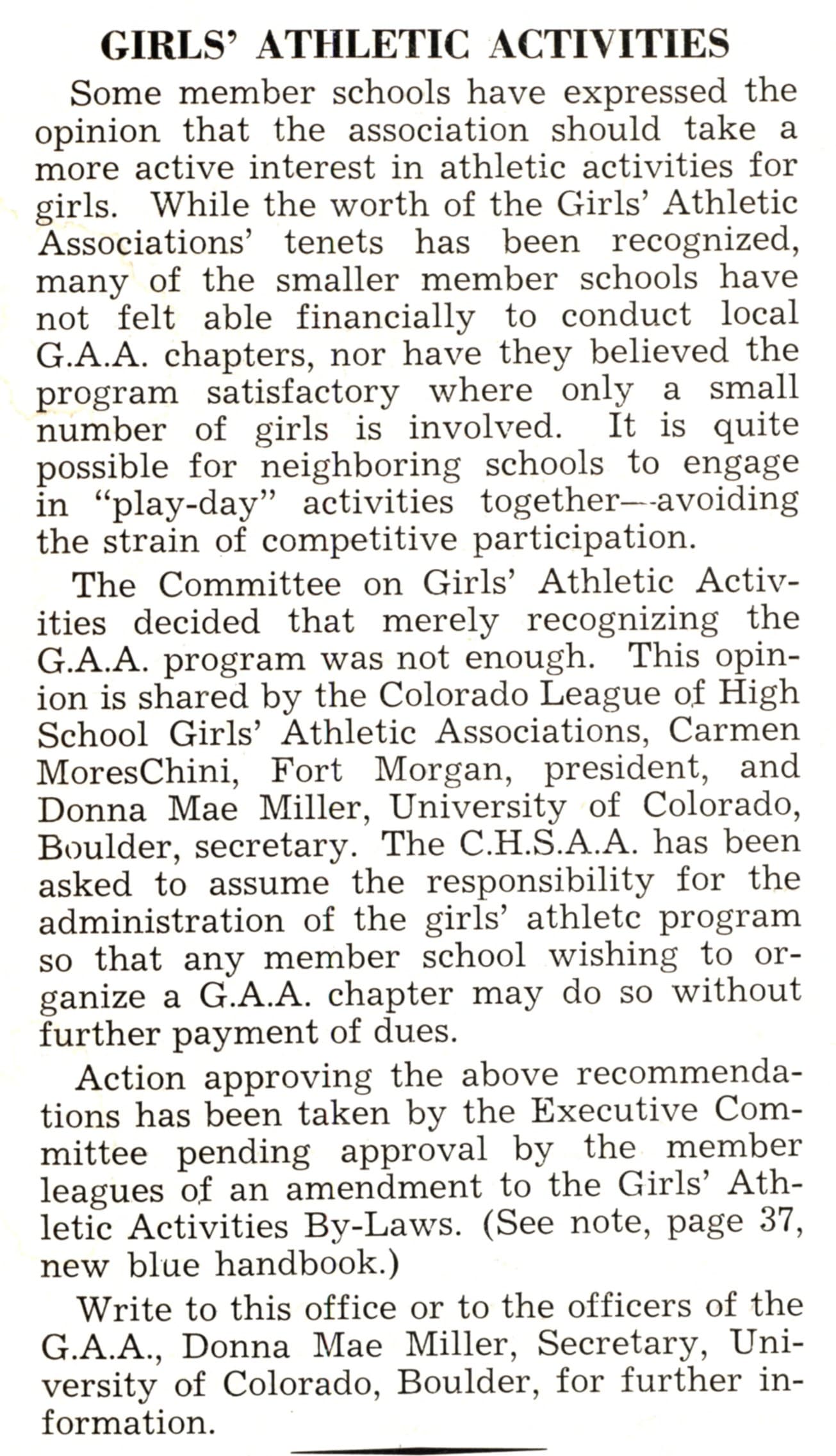
The GAA makes a formal request to be integrated into CHSAA, and have the Commissioner serve as the coordinator of GAA activities. Member schools approve this change. While a step forward for girls athletics, this organization specifically did not want girls playing competitively — not even keeping score.
It is integrated into CHSAA in a way that the Association disseminates the GAA's rules and bylaws, but does not offer sanctioned sports.
1951
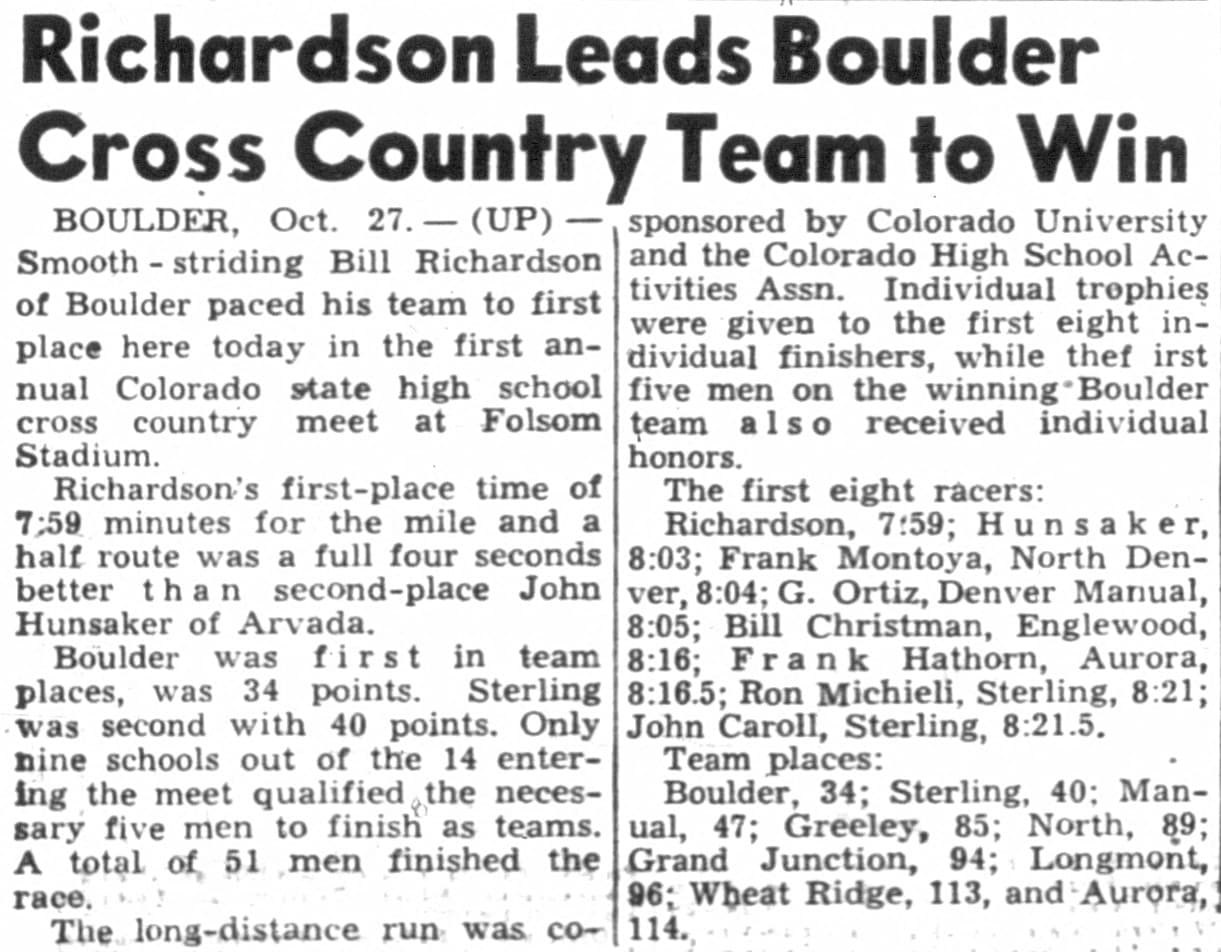
The first annual Colorado state high school cross country meet is held at Folsom Stadium in Boulder — a mile-and-a-half course co-sponsored by the University of Colorado and CHSAA. Boulder wins with 34 points; Bill Richardson of Boulder takes individual honors in 7:59.
1951
One year after joining, baseball adds a new classification. Teams compete in Classes AA, A and B.
1952
The annual NFHS Summer Meeting is held in Estes Park, the first time it is in Colorado. More than 500 people attend, from 45 states.
1953
The Board of Control rules that all interscholastic activities should be under CHSAA's sanction, which at the time includes music, speech and student council.
An Assistant Commissioner is hired for the first time: Wendall K. Beard. He had been the principal at Greeley High School. With this hire, CHSAA rents additional space in the CEA building.
1953
A new bylaw disallowing contests and practices on Sundays is implemented. Prior to this time, it was a common practice to not play or practice on Sundays.
Additionally, a bylaw suggests that all competition be played on Friday and Saturdays "in so far as possible." It adds: "Only in special cases shall they be scheduled on nights preceding school days."
1953
The rapid growth of baseball continues following its official sanctioning. Three years after the first championship, the sports adds a fourth classification: Class C.
1956
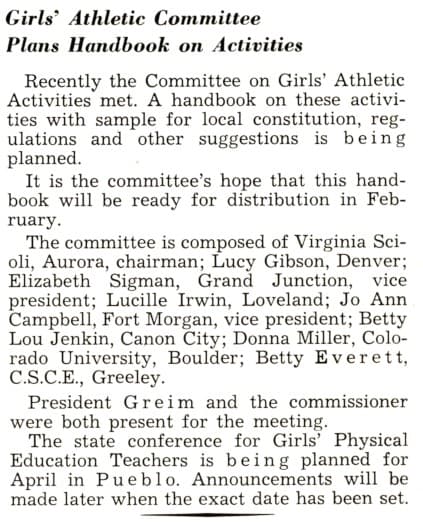
In the "Girls' Athletic Activities By-Laws," which were written in 1953, a new section specifically states that "there shall be no interscholastic competitive sports for girls in which all members of any participating team are from the same school, nor shall all the actual participating players on a team at any time during a contest be from the same school."
Another section details that no competition should "determine a league or district champion nor shall it be done for the purpose of selecting a school as the meet or contest winner." Furthermore, according to the bylaw, competition "shall not be scored for the purpose of determining a 'winning team' either through the awarding of points or through any other plan of scoring."
1956
Football's classifications grow once again, this time adding Class AAA — the sport's fifth.
1956
Cross country splits into two classifications: Division I and Division II.
1957
Football's Class C changes from 6-man to 8-man.
1957
Wrestling splits into two classifications: Division I and Division II.
1958
The age rule is clarified to read that anyone who turns 19 is ineligible to play, unless their 19th birthday occurs after Aug. 25 of that school year.
1958
Basketball adds a fifth classification. Teams now compete in Classes AAA, AA, A, B and C.
1959
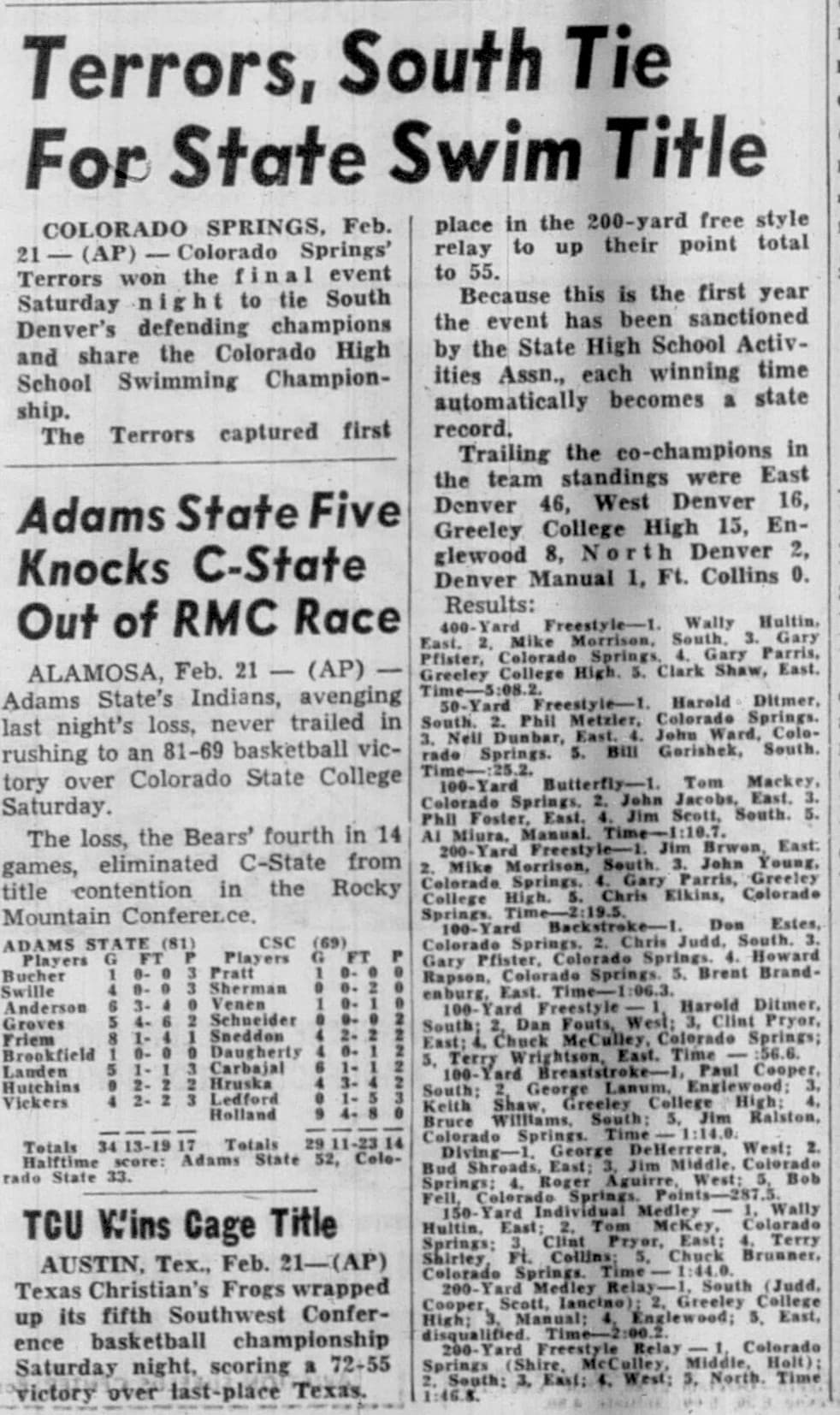
CHSAA adds boys swimming to its list of sanctioned sports. At the first sanctioned state meet, hosted by Colorado Springs High School, Colorado Springs and Denver South tie for the team title at 55 points apiece — co-champions. Because it is the first CHSAA-sanctioned year, each winning time becomes a state record.
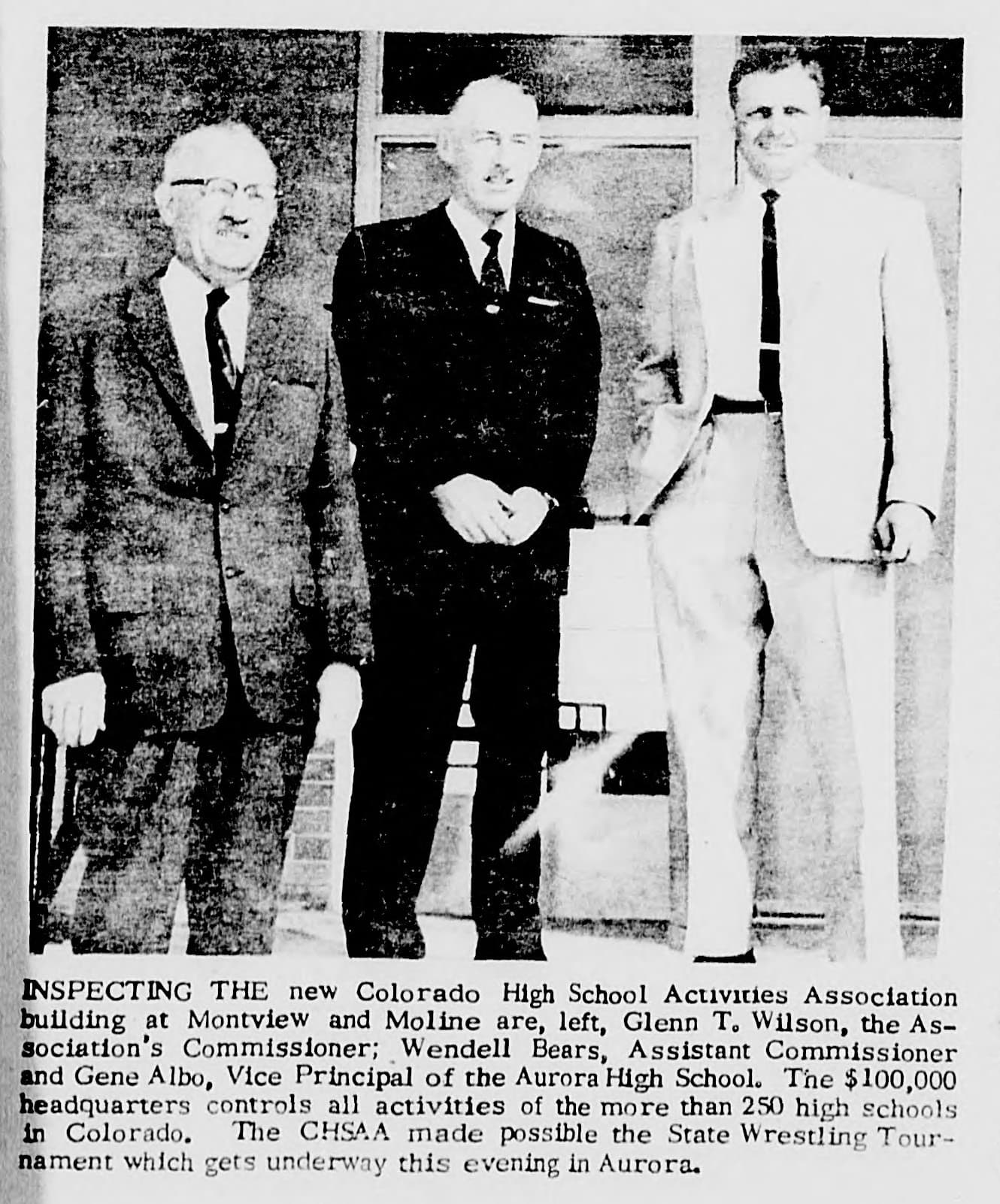
The CHSAA moves into a new office building, one that for the first time, is entirely its own. It is located at Montview Blvd. and Moline in Aurora — a roughly $100,000 headquarters serving more than 250 member high schools. It is eventually remodeled in 1968, and again in 1973 and 1974, mostly to add new office space.
In his retirement speech, Commissioner Wilson notes that this move "was a highlight in the history of CHSAA. It added many needed facilities and prestige to the organization."
1960
Still, girls are not allowed equal treatment: "Sports must be organized so that no regular schedules are played and no inter-school or league champions are named." No admission was permitted to be charged, and they are not allowed to play in front of spectators.
1961
Boys cross country adds a third class: Division III.
1962
Baseball adds a fifth classification: Class AAA, joining AA, A, B and C.
Boys track also adds a Class AAA, giving it four classes.
1964
Girls are permitted to play archery, badminton, golf and tennis. They can also participate in gymnastics, swimming and track and field, "provided no team scores are recorded." The stance remains against interscholastic competition for girls. "Nothing in this article shall be interpreted to mean that CHSAA schools may develop girls' athletics on a formal schedule basis or that championships shall be permitted."
Later, in 1973, these policies are called out for delaying and restraining the progress of girls sports.
1964
Football shrinks to four classes: Class AAA, AA, A and the newly-renamed 8-man, which is no longer known as Class C.
1965
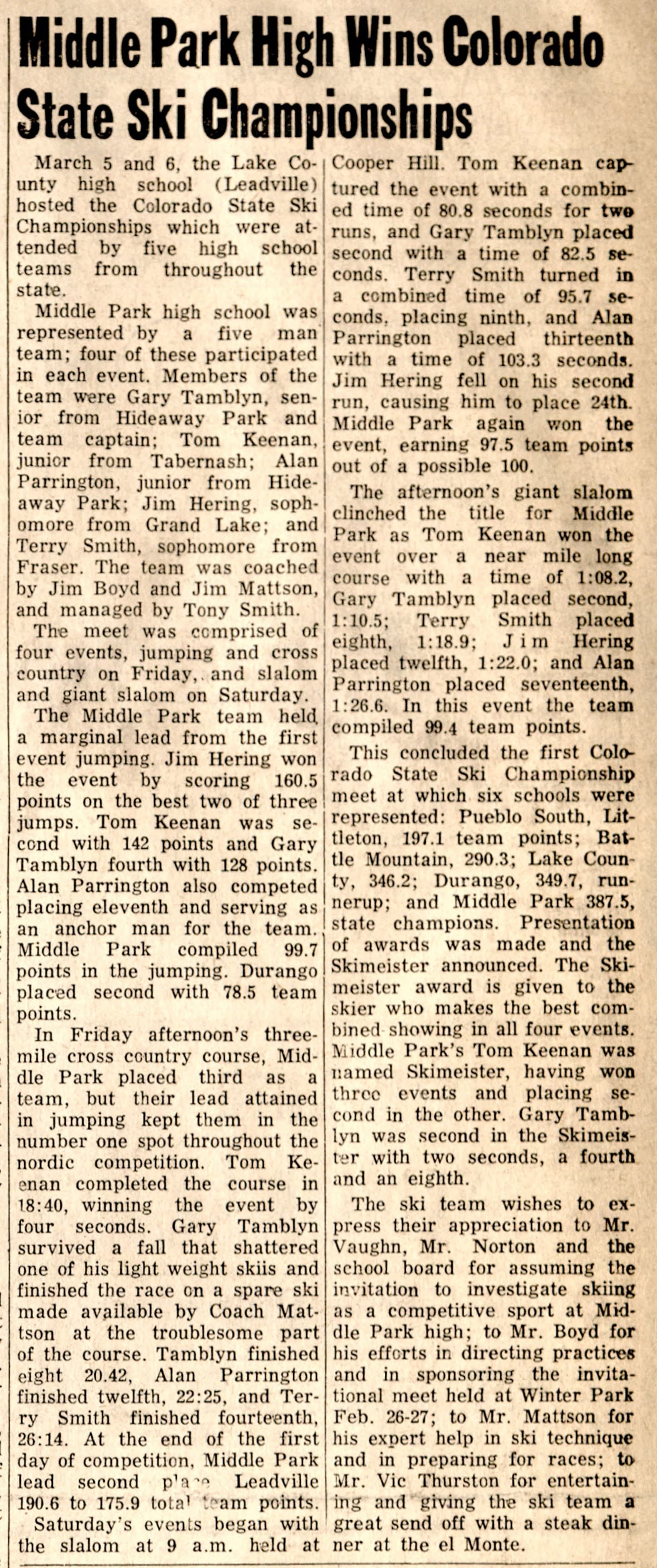
The first Colorado State Ski Championship meet is held March 5–6 at Cooper Hill, hosted by Lake County High School. Middle Park wins with 387.5 points, ahead of Durango. Tom Keenan of Middle Park takes the Skimeister award.
1965
The classification system undergoes its first major overhaul since sports were split into classes. All sports do away with Classes B and C.
Football remains the same from the previous year, and both track and basketball shrink to three classes (AAA, AA and A). Baseball has four classes: AAA, AA, as well as A West and A East.
Feb. 1966
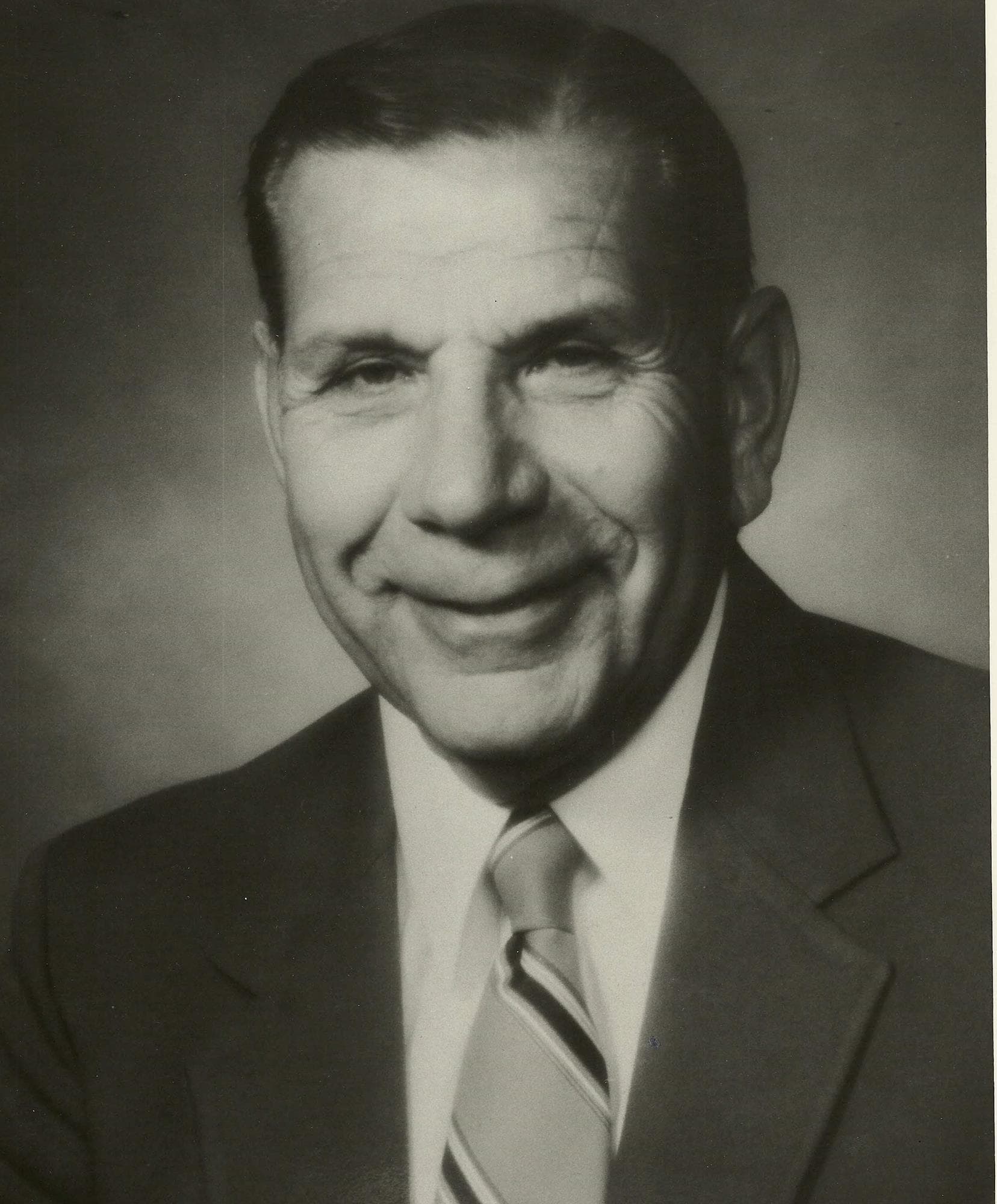
Ray C. Ball is hired as CHSAA's fourth Commissioner, and will serve for 20 years and six months. A graduate of Denver South, Ball was a football coach at Lakewood and principal at Bear Creek. He also was an active college football official.
Ball was ahead of his time in many ways. As Bob Ottewill wrote in his document, The History of CHSAA, "Ray was a brilliant thinker and an innovator who created the professional image of the Association and many of the services we have today. ... He left a foundation that has allowed the Association to thrive into the 21st century."
Ball's tenure saw the inclusion of private schools into CHSAA, as well as the creation of a catastrophic insurance plan which covers every member school.
He grew CHSAA from offering 10 sports to 22.
His biggest legacy? The full inclusion of girls sports into CHSAA.
1967
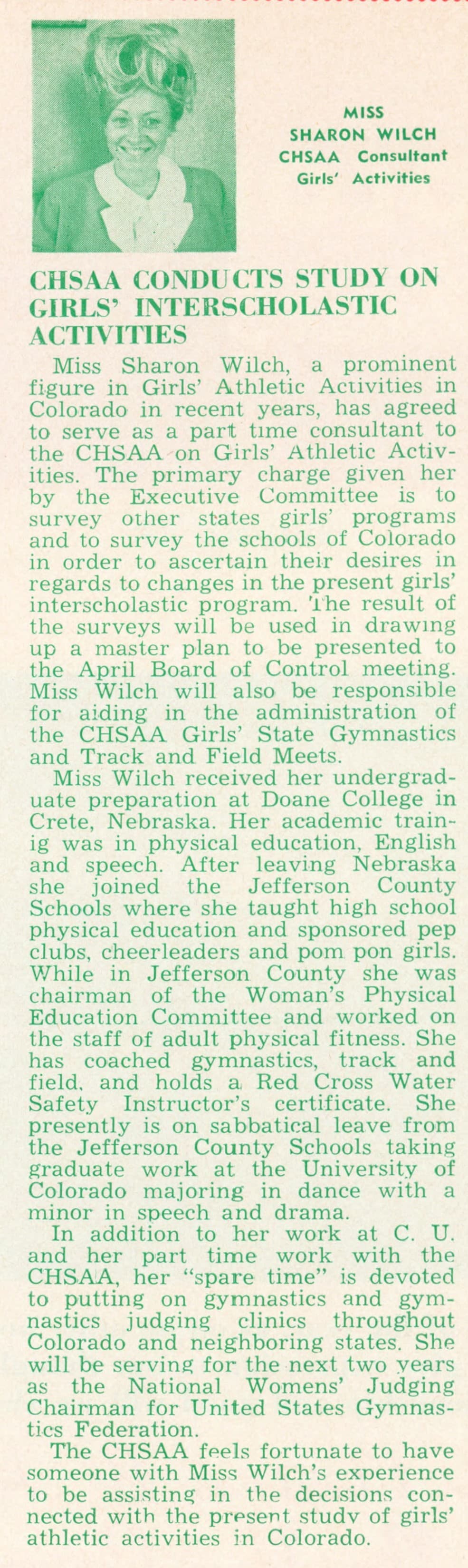
Girls gymnastics becomes the first girls sport to have its own entry into the CHSAA bylaws, setting dates for the season, and granting permission to create regional and state meets. No official champion is recognized. That same year, the Interscholastic reports on a CHSAA study of girls’ interscholastic activities.
1967
After years of trying, private schools join CHSAA for the first time, moving over from the Parochial League. The initial private school members were Mullen, Regis and St. Mary's.
1969
A new policy prohibiting competition and practice from Dec. 24 to Jan. 1 each year is passed. It goes into effect in the 1970-71 school year, and a version of it has been in the CHSAA bylaws ever since. It was moved from policies to bylaws in 1987.
In 2008, voluntary practice on select dates was permitted.
1969
The list of recognized girls sports is revised to include skiing, and get rid of golf, badminton and archery. The list as of this time: Gymnastics, skiing, swimming and track and field. Still, team scores are not permitted to be "recorded."
1969
Wrestling changes from its Division I and Division II format to three classes: AAA, AA and A.
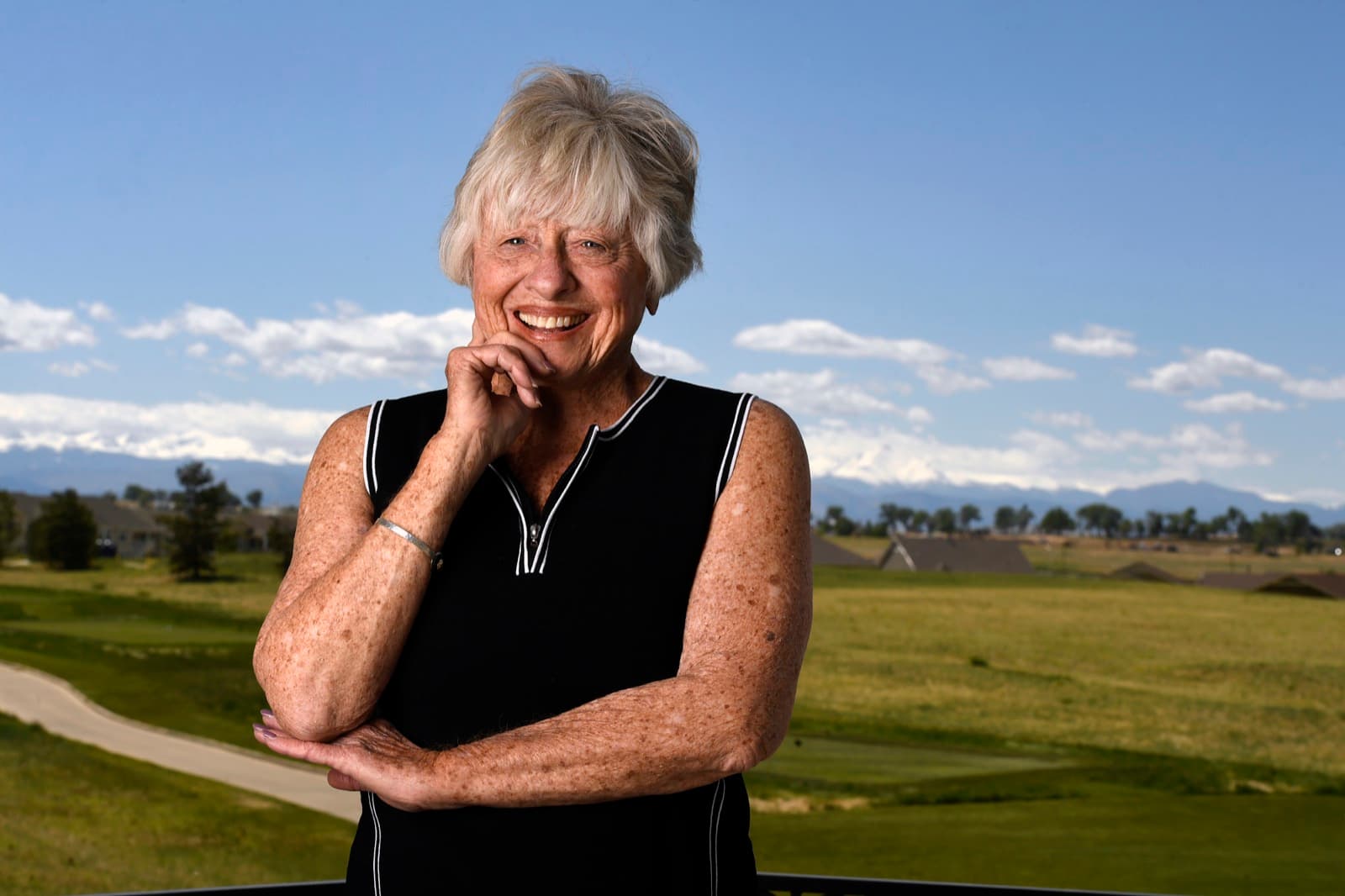
Sharon Wilch, a Jefferson County PE teacher, joins the CHSAA staff — the Association’s first female administrator, and one of the first in the nation — to help build an official girls sports program.
1970
A new Girls' Sports Coordinating Committee (GSCC) is formed. It "recommends that there shall be no emphasis placed on the winning of championships and that no formal schedule for girls' sports shall be sanctioned by the CHSAA."
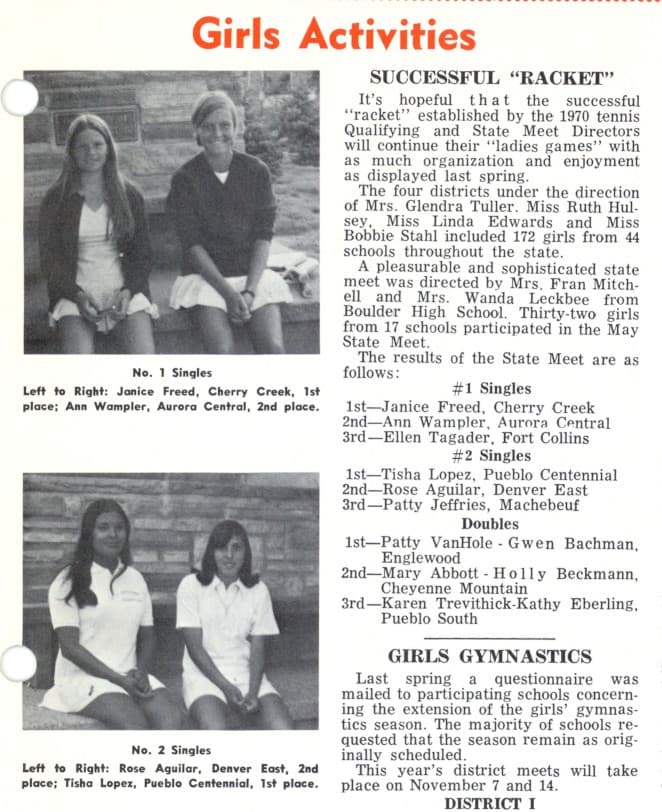
CHSAA stages a girls state tennis tournament — an individual culminating event with singles and doubles results published in the Interscholastic. Team championships are still not awarded. By 1972 the Interscholastic is billing it as the “third annual” girls state tennis tournament, confirming 1970 as the first year of that meet series. Official team titles arrive later, in 1975.
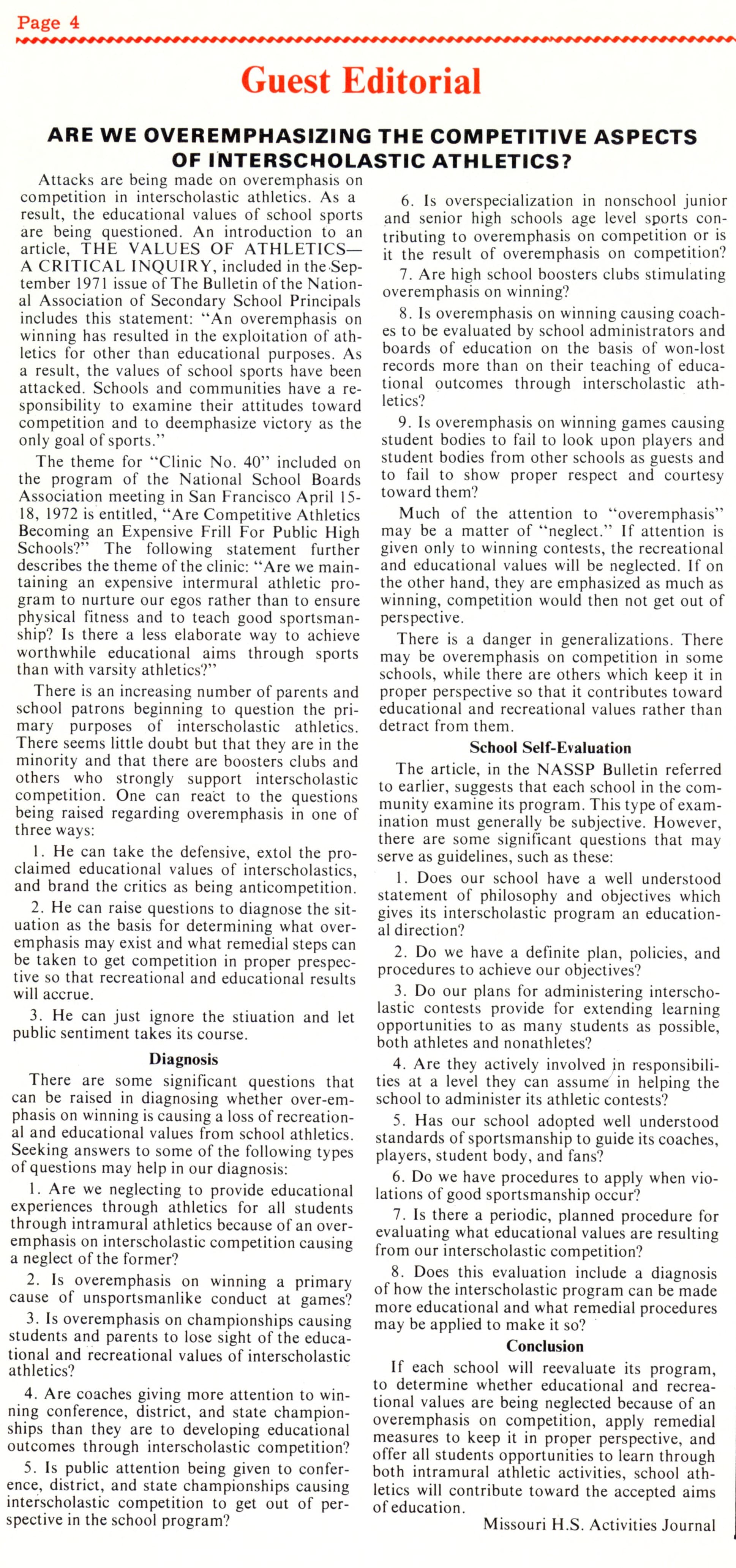
1971
Even as equal treatment for girls sports is gaining steam, the InterScholastic—writes an editorial effectively patronizing girls sports, saying that there are challenges finding "qualified women" to coach, and questioning how facilities could handle concurrent boys and girls programs.
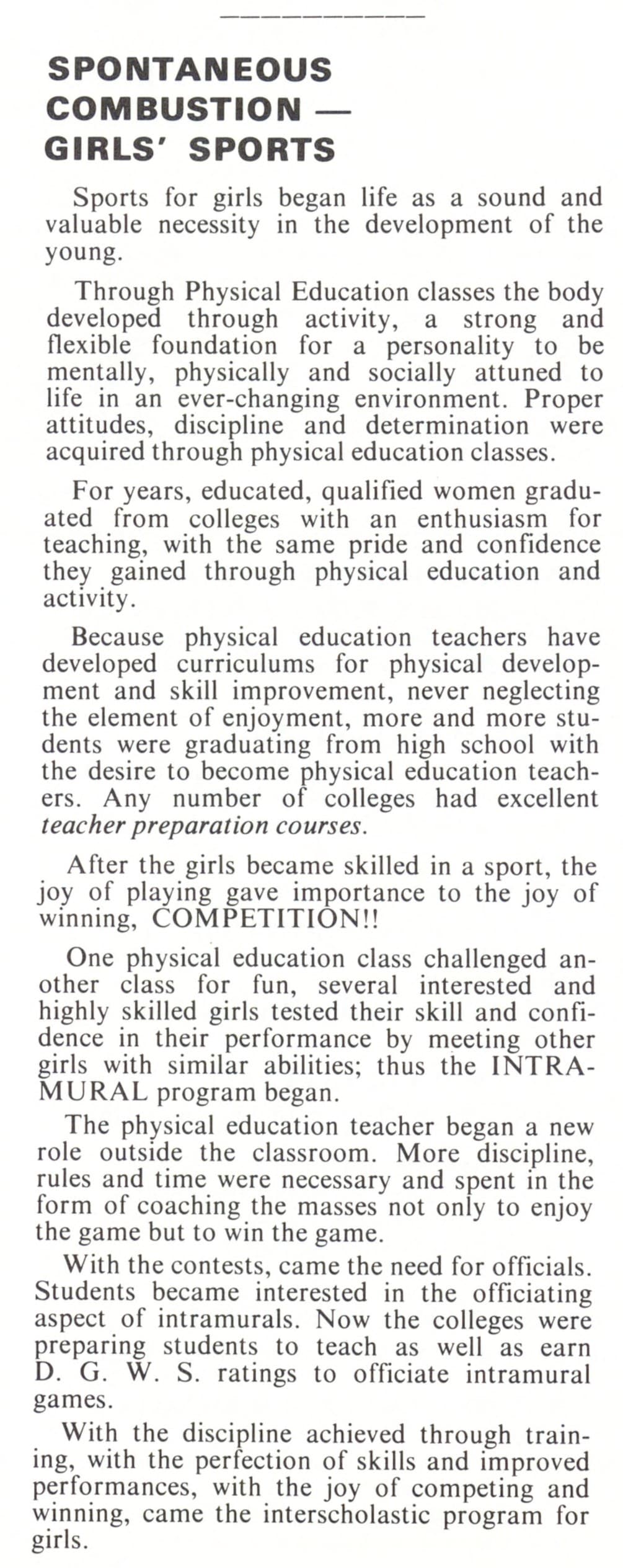
They co-sign an editorial from the Wisconsin association arguing that girls sports "must be conducted as an outgrowth of the intramural program."
1972
The GSCC introduces the terms "intramural" and "extramural" into the bylaws, and makes a definite effort to promote intramurals over competition between schools. According to a bylaw: "The instructional and intramural program should have priority even if an interscholastic program is offered."
In a small sign of progress, gymnastics, skiing, tennis, and track and field are permitted to keep score during regular season contests.
June 23, 1972
Title IX of the Education Amendments of 1972 is passed, requires that males and females be provided equitable opportunities to participate in sports. It is instrumental in providing increased athletic opportunities for females across the country. The impact upon high school sports in Colorado, however, is not immediate.
Fall 1972
CHSAA's Board of Control approves girls to field teams sports. However, "there will be no district or state championships in team sports."
Team scores are permitted to be recorded in individual sports "at the local league levels" but there still "will be no district or state team championships awarded for individual sports."
April 9-10, 1973
The Board of Control passes a motion "which could eventually pave the way for a girls' state basketball tournament." It requires every school to use NFHS rules.
1973
Girls swimming is added as a sanctioned sport. The first state meet is held, and individual champions were recognized, though no team scoring was recorded. Cherry Creek swimmers win 10 of the 12 events.
The InterScholastic—notes that, "Indications are that team scoring will be instituted in state meets for the 1974-75 school year."
1973
Baseball permits aluminum bats to be used in all games.
April 1974
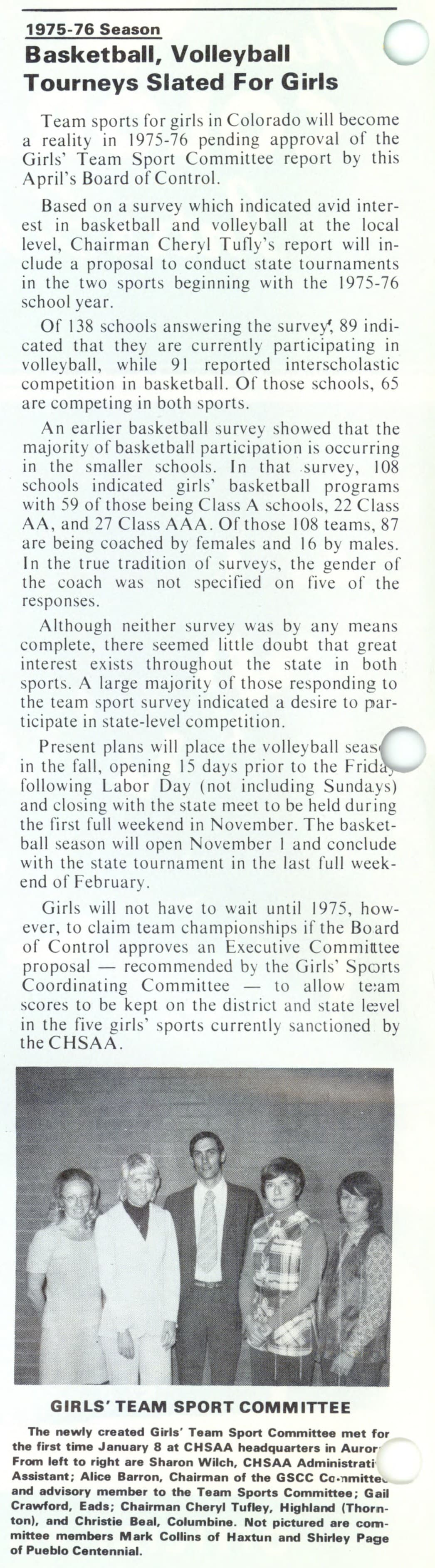
Girls sports take a major step forward with two votes at the Board of Control meeting.
The first proposal, which came from the Executive Committee, permits team scoring and team championships in individual sports, starting with the 1974-75 school year.
The second proposal, from the Girls Team Sport Committee, is also approved, which means that girls team sports are finally included in CHSAA. The team sports are set to begin in the 1975-76 season. Initial team sports offered will be volleyball and basketball.
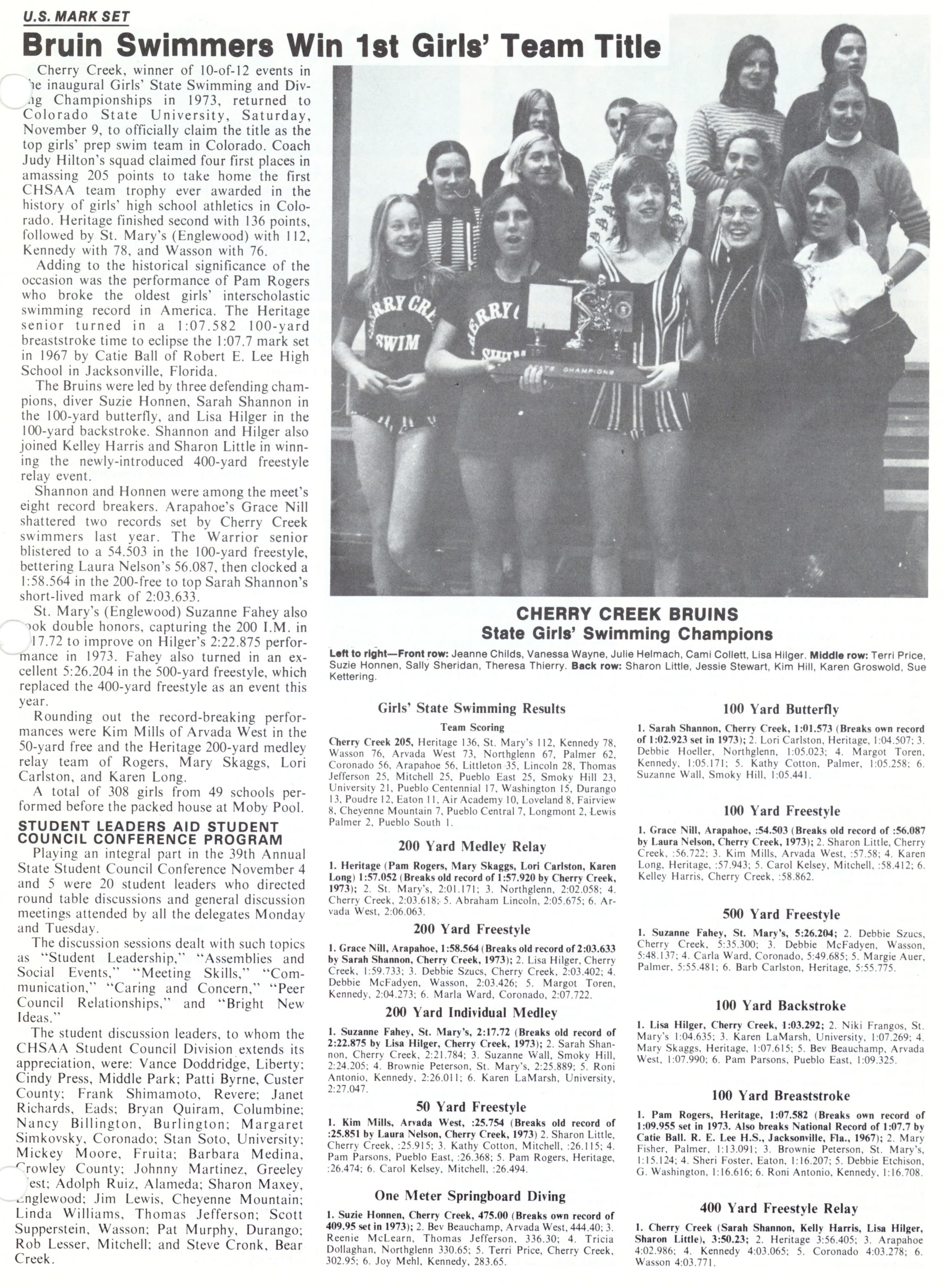
Girls gymnastics (Bear Creek) and girls swimming (Cherry Creek) crown the first official girls champions — the first team titles awarded after scoring and championships are opened for individual sports.
1975–76
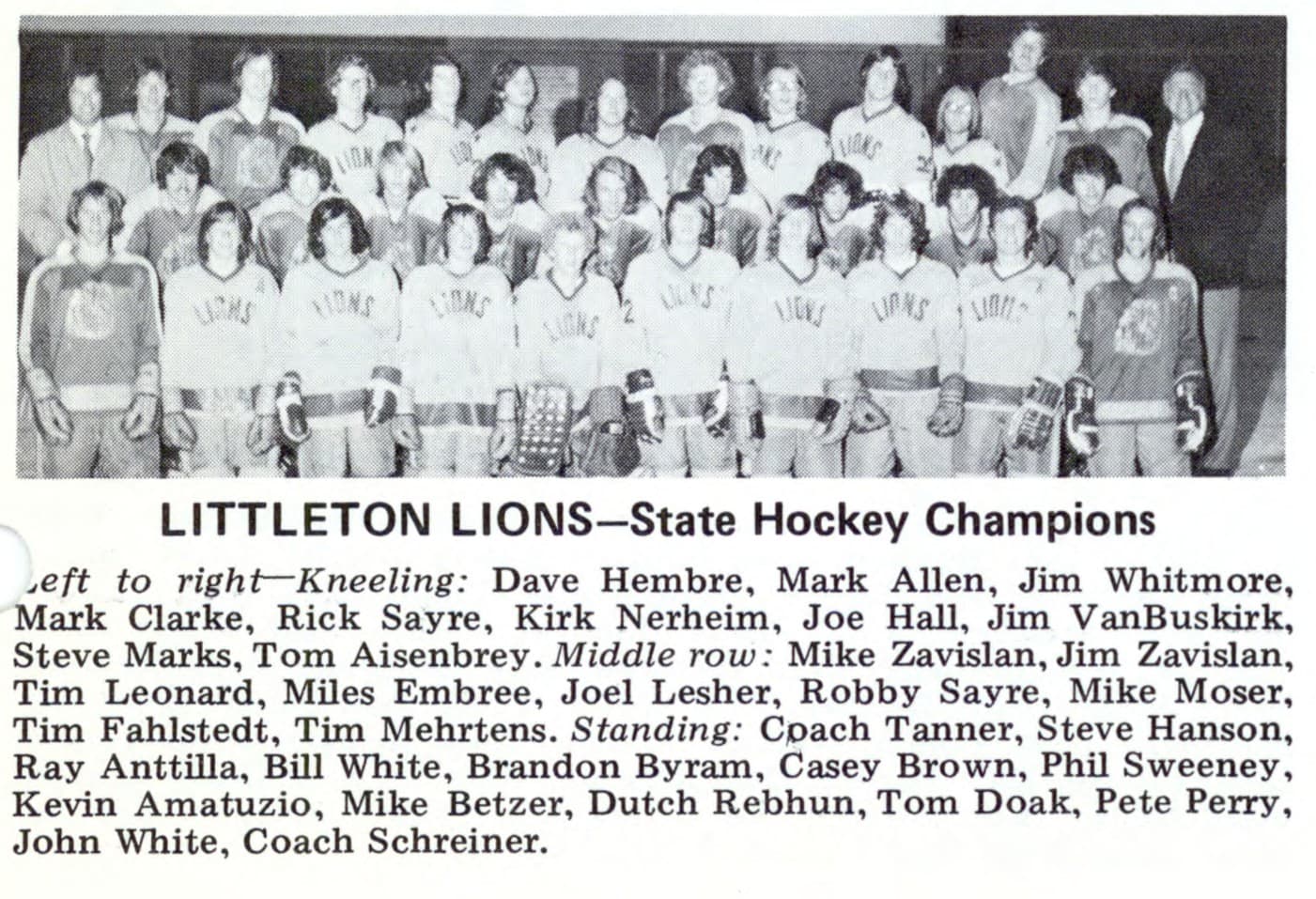
Ice hockey’s inaugural culminating season produces a wild title game: Littleton defeats Cheyenne Mountain 9–8 for the first prep state hockey championship.
Winter & Spring 1975
The following winter, girls skiing names a champion for the first time: Middle Park.
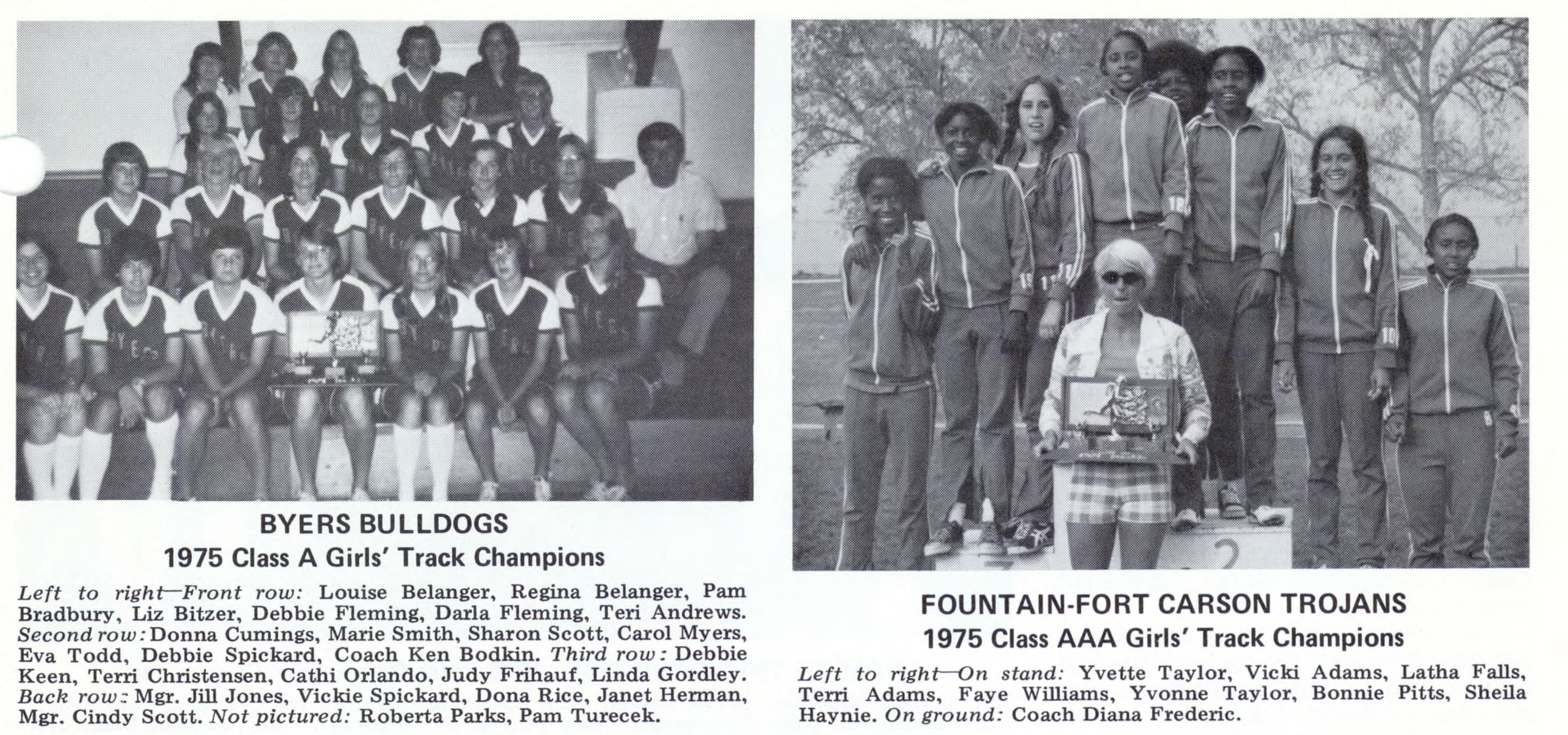
That spring, girls track and field crowns four champions, the first in the sport's history: Fountain-Fort Carson (AAA), Byers (A), and also co-champions Gunnison and University (who tied in Class AA).
Girls tennis awards its first official team championship, with Thomas Jefferson winning — distinct from the earlier individual state tennis meets that began in 1970.
1975
Finally, after decades of fighting — and after a federal civil rights law — girls sports are given equal treatment. The bylaws are merged to cover both boys and girls sports.
Under the major changes, the following is written: "The CHSAA, in order to effectively equalize athletic opportunities for members of both sexes, promotes and encourages the use of comparable athletic teams for members of each sex where selection for such teams is based upon competitive skills. This effort is to promote and encourage the growth of female involvement in athletic programs sponsored by this organization."
All references to not allowing score to be kept and the disallowing of spectators are deleted.
1975
The age rule is given a slight update. It now reads that any student is ineligible upon turning 19, unless that 19th birthday occurs on or after August 1. A version of this rule is in place today.
1975
Basketball and volleyball join gymnastics, skiing, tennis and track and field as girls sports.
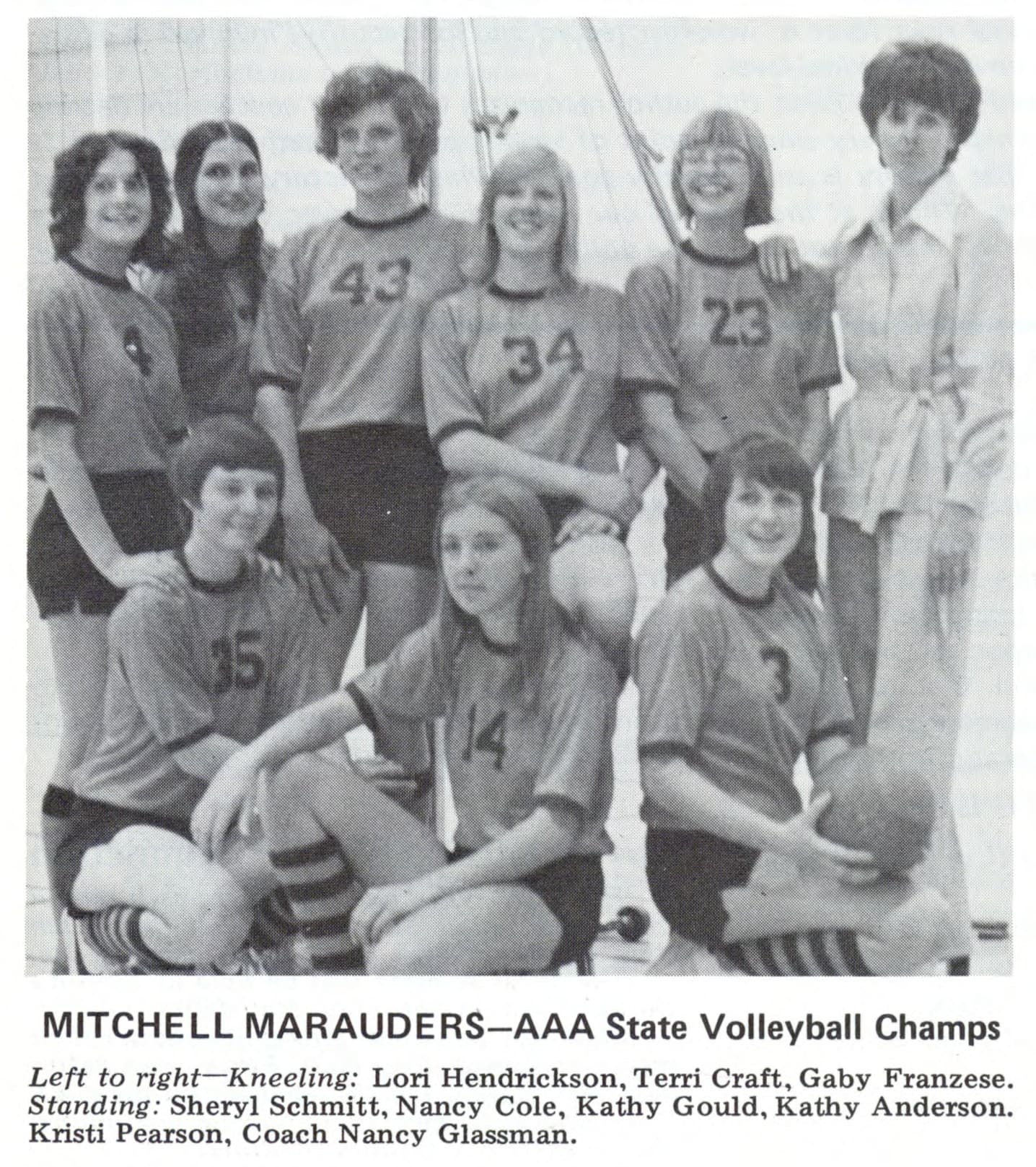
Fall 1975
Volleyball holds its first culminating event for the girls. Mitchell, Valley and Prairie win championships. It is the first "team" sport to hold a championship in CHSAA history.
In a follow-up article, the InterScholastic notes that the tournament "put to rest any notion that girls athletics cannot generate the type of spectator enthusiasm witnessed at boys events." A capacity crowd of 2,500 shows up to watch the finals at the old Highland High School in Thornton.
Fall 1975
Boys soccer is added as a sport in 1975. Cherry Creek wins the first championship with a 4-0 victory over Columbine.
1976
The NFHS passes a rule allowing the use of a designated hitter in baseball. It is first used in Colorado in the spring of 1976. This rule remains in effect today.
1976
The bylaw disallowing competition at nights prior to school days is eliminated.
1976
Girls gymnastics adds a second classification. Teams are now split into Class AAA and Class A-AA.
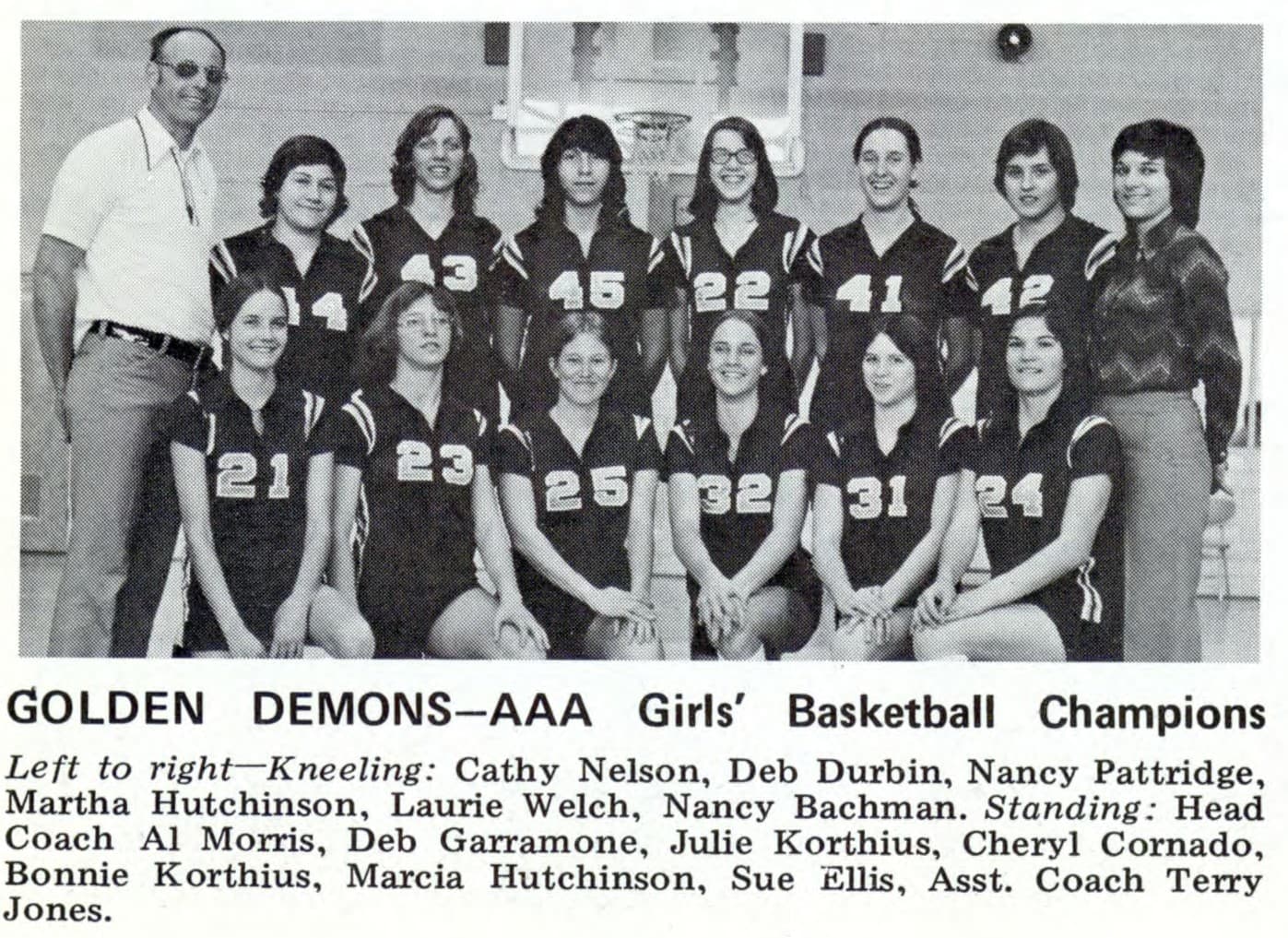
Winter 1976
Golden (Class AAA), Wray (AA) and Campo (A) win the first girls basketball titles.
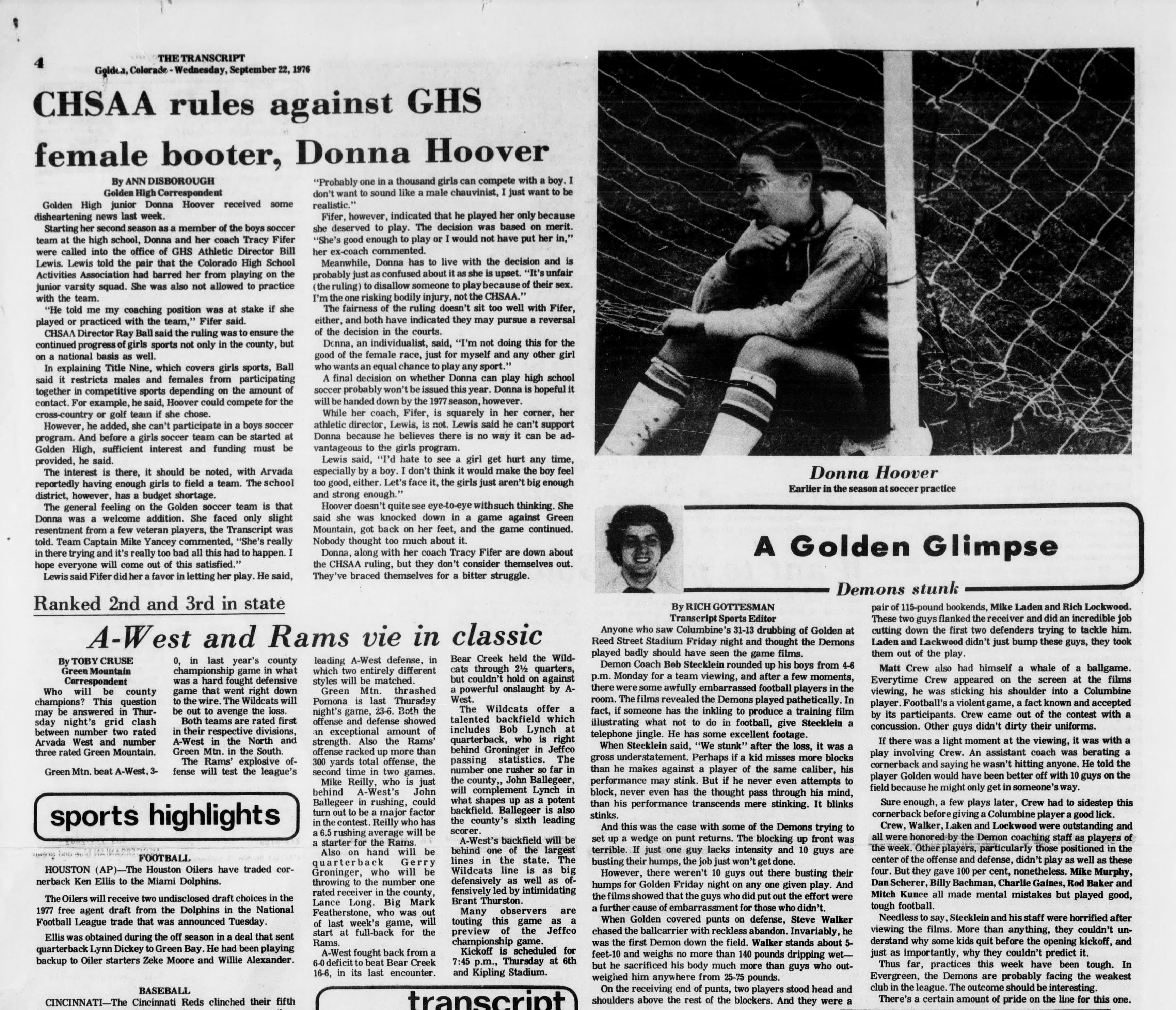
April 26, 1977
In a vote during a special meeting, the Executive Committee votes to "remove soccer from the list of activities sanctioned by the CHSAA, effective immediately," according to the InterScholastic.
The move comes following a decision by a United States District Court in a class-action lawsuit brought by Donna Hoover, at the time a junior at Golden High School.
Hoover had been participating with Golden's boys soccer program at the junior varsity level, but her principal ordered her removed from the team, because it was a violation of a CHSAA rule which classified soccer as a male-only sport.
Soccer had only been sanctioned four years previous, and held its first championship in 1975. The lawsuit sought sanctioning for girls soccer.
Judge Richard P. Matsch makes a ruling in late March, ordering that either Hoover (and other females) be permitted to play on the boys team, that CHSAA offer girls soccer in addition to boys soccer, or that CHSAA may opt to drop sanctioning for boys soccer.
CHSAA opts to drop sanctioning for boys soccer, and not add girls soccer. The reasoning, from the Executive Committee, was that it was not "the purpose of the association to create new activities, but instead to govern those which develop through the interest of member schools." In other words, the committee determined, "schools select the programs and instruct CHSAA to regulate them."
Fortunately, this evolves rapidly.
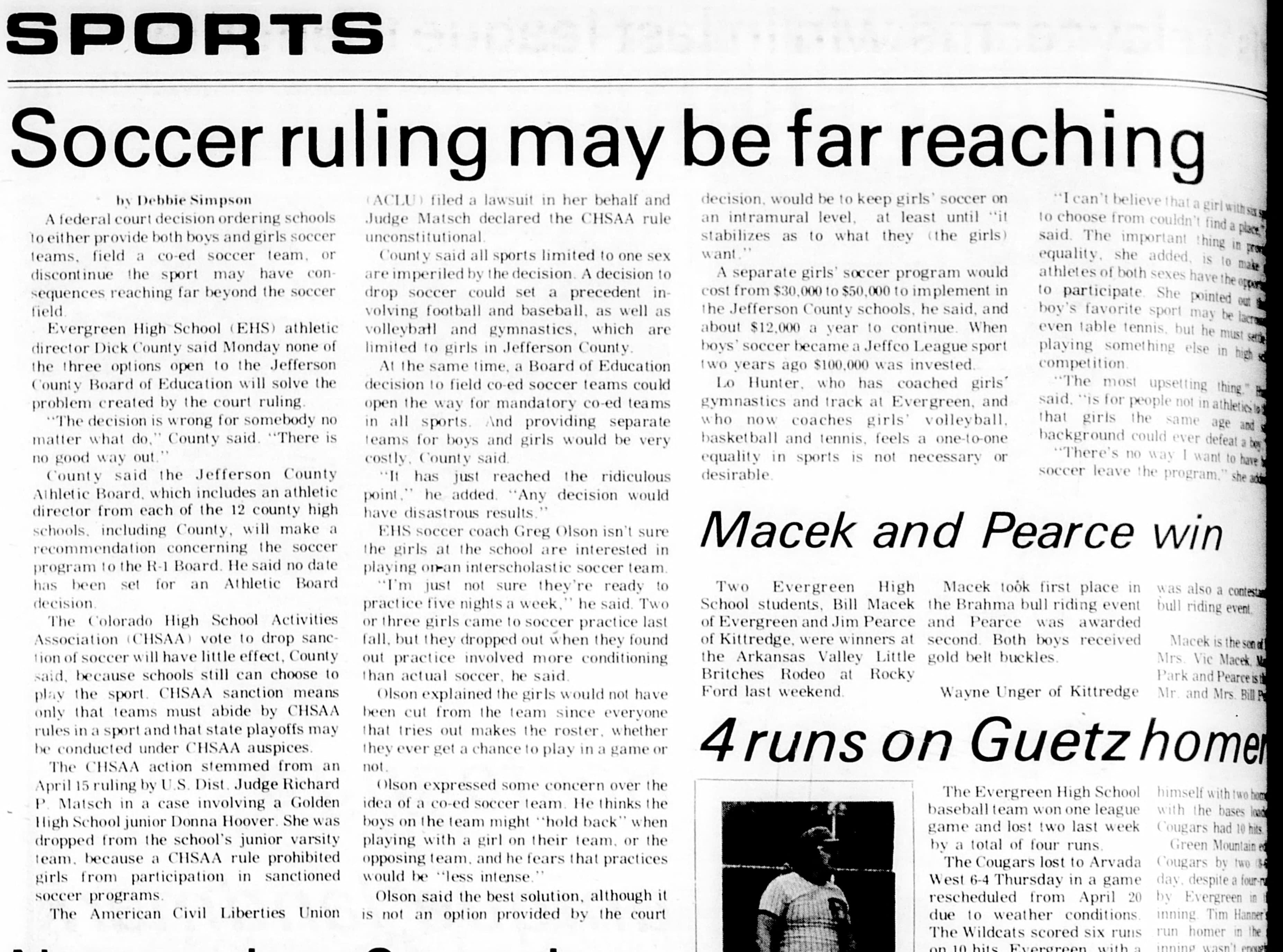
July 20, 1977
Though they hadn't planned on revisiting the issue of soccer sanctioning until April 1978, the Executive Committee reverses course entirely, and sanctions not only boys soccer but adds girls soccer, too.
Just one week after their April 26 meeting, the Executive Committee meets again on June 3, where the Skyline League requests that both boys and girls soccer be sanctioned. A survey of member schools indicates that 40 schools would be fielding girls soccer teams in the spring, regardless of sanctioning. This shows the Executive Committee that sanctioning should be considered.
Shortly after, the Centennial, Jefferson County and Denver leagues all submit requests for sanctioning.
As a result, at its July meeting, the Executive Committee ultimately votes to establish a set of girls soccer bylaws, and reinstate boys soccer. The first girls season will be held in the spring of 1978, and the boys don't miss a season, continuing their play in the fall of 1977.
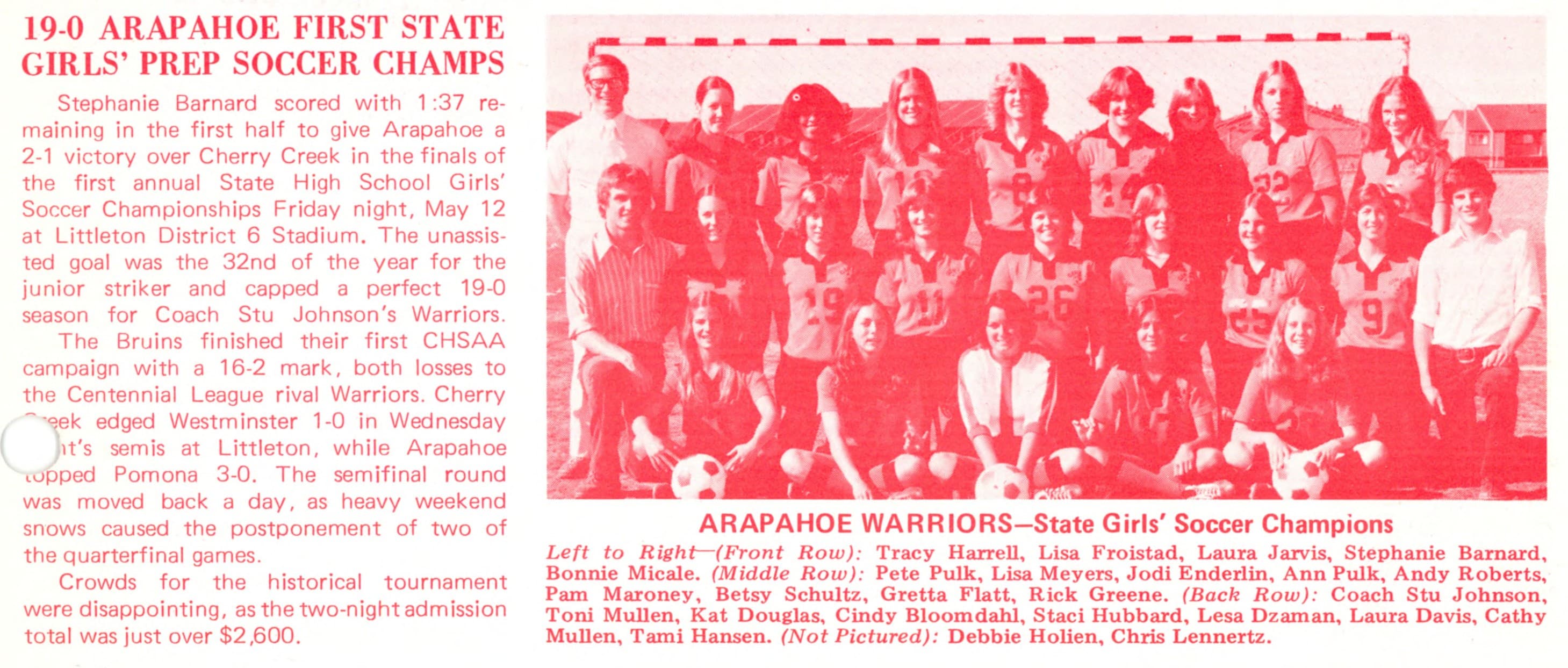
Spring 1978
Arapahoe beats Cherry Creek 2-1 in the first girls soccer championship match.
1978
Football grows to five classes: 4A, 3A, AA, A and 8-man.
1978
Baseball merges its A West and A East classifications into a single class: Class A. The sport now has three classes.
Fall 1978
Centauri (Division II) and Pueblo East (Division I) win the first girls cross country championships.
1981
Boys and girls basketball have their classifications overhauled. Teams now compete in five classes: Class 4A, 3A, AA (2A for the girls), A-I and A-II.
1983
Girls volleyball expands to five classes: 4A, 3A, AA, A-I and A-II.
1986
For the first time since it went away in 1957, CHSAA offers a 6-man football division. There are now six football classes: 4A, 3A, AA, A, 8-man and 6-man.
1986
Girls are permitted to play football.
Aug. 1986
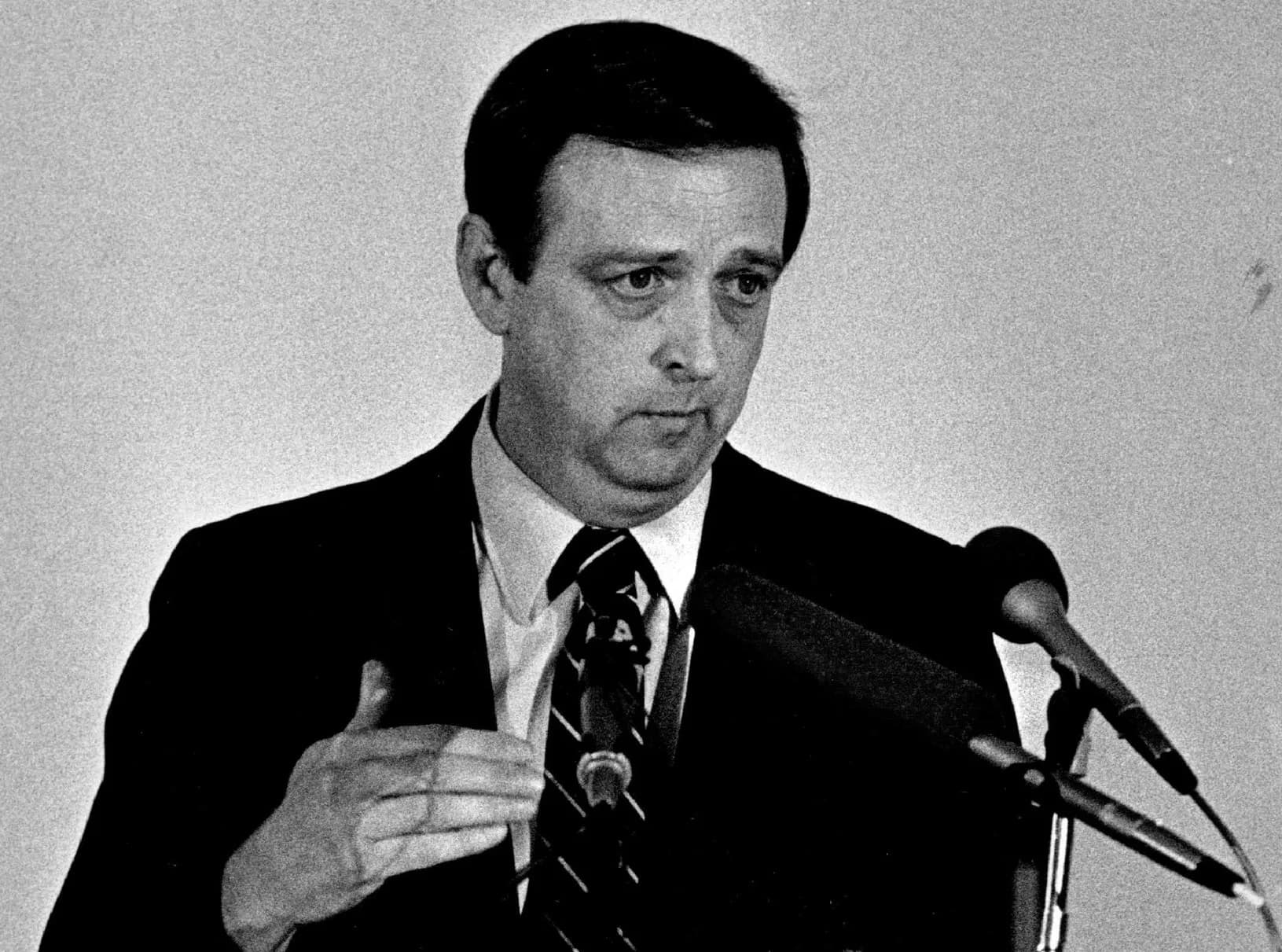
Ray Plutko, who led a section office for California's state high school association, is hired as Ball's replacement as Commissioner. He serves for four years.
Plutko brought in a lot of new ideas which helped set the stage for the modern Association, including the reorganization of some state tournaments to bring them together to one site. Plutko also initiated corporate partnerships.
1987
Boulder beats Pomona 2-0 in the first-ever softball championship game.
1989
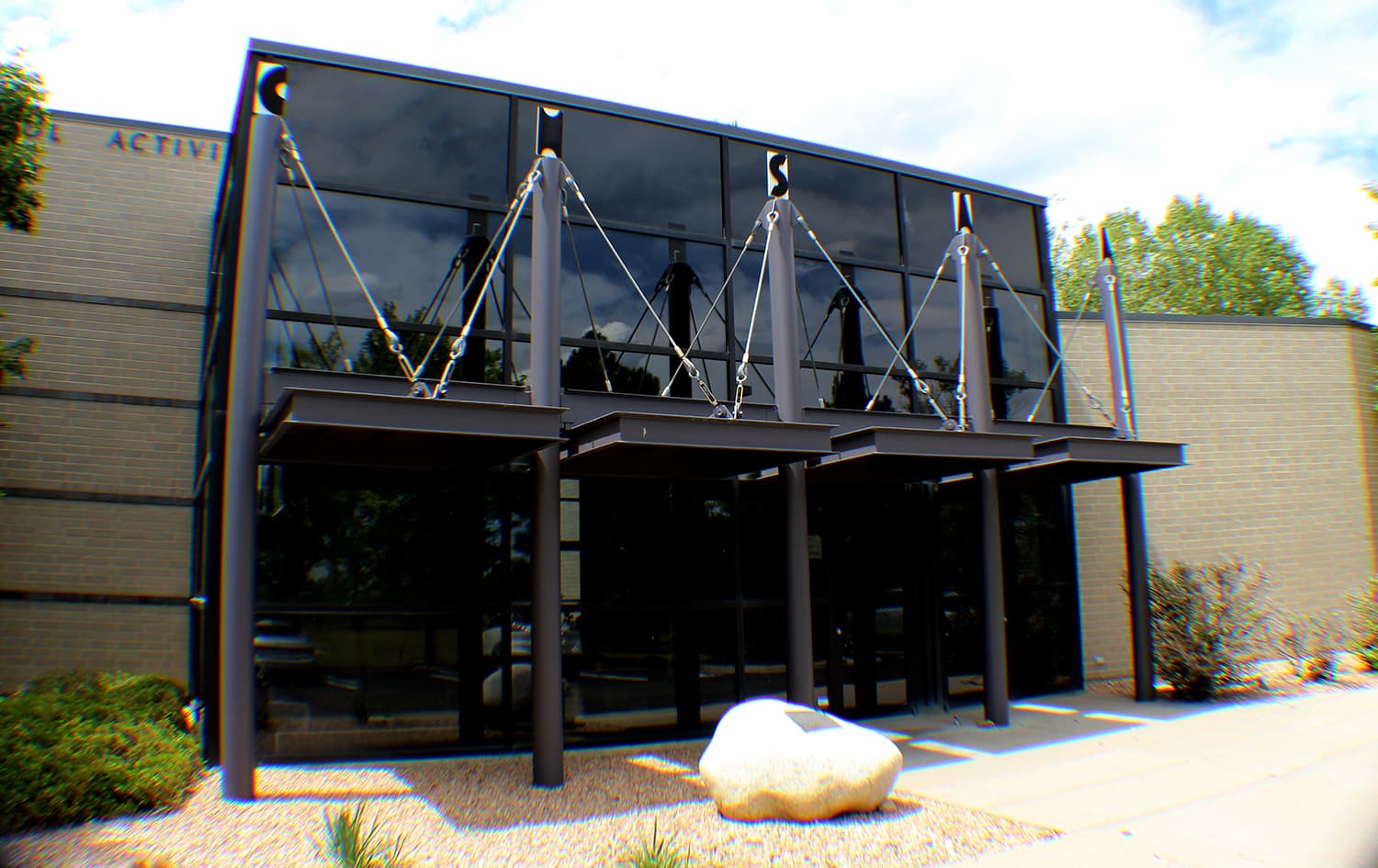
The CHSAA office moves again, this time to its current location at Sable Blvd. and 2nd Ave. in Aurora.
1990
Though initially offered as a sport during the tumultuous fight for equal treatment in the 1960s, and then subsequently removed as a sanctioned sport, the first girls golf championships are held in 1990. Cherry Creek wins.
July 1990
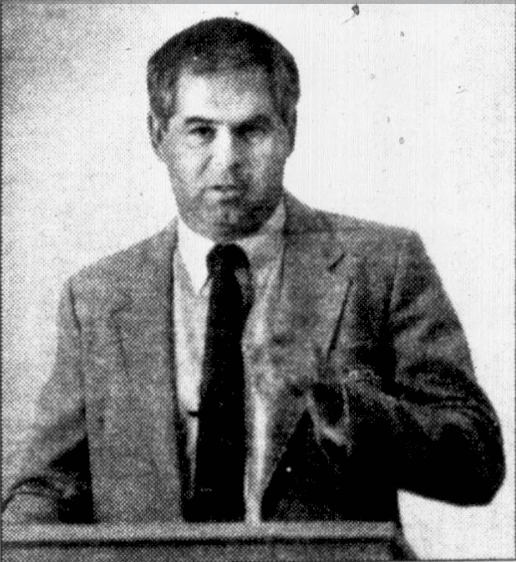
Bob Ottewill, a longtime CHSAA administrator who was first hired in 1972, and later Associate Commissioner, is hired to replace Plutko.
Ottewill helped steer the Association out of some financial trouble which arose from the new office building. He also helped to navigate CHSAA through the creation of school choice in Colorado, and the fallout around the transfer rule that resulted.
A strong advocate for gender equity, he helped grow opportunities for girls with the addition of golf, lacrosse, field hockey and spirit during his 12-year tenure.
Fall 1990
For the first time 25 years, CHSAA undergoes a major overhaul of the classification system.
Gone are the mixing and matching of classification names (AAA, AA, A, A-I, A-II, as well as Division I and Division II). They are replaced by the naming convention still used today: 5A, 4A, 3A, 2A and 1A.
A new large classification — Class 6A — is added at various times in football, volleyball, soccer, gymnastics, cross country, softball, spirit, tennis, basketball, wrestling, baseball and track. It lasts until 1995, when the classification system is reverted to five classes for most sports.
Football is the biggest sport with seven classes. Volleyball and basketball have six classes; wrestling, track and baseball have five; cross country and soccer both have three; while girls gymnastics, softball, tennis, cheer, and swimming each have two. All other sports remain unclassified.
1991
Arapahoe and Montbello claim titles in cheer, the first-ever sanctioned spirit championships.
1991
The final boys gymnastics championship is held, with Loveland winning.
1992
Spirit expands for the first time, and adds pom along with cheer. There are three classes of each division.
1993
Spirit adds another new division: Co-Ed Cheer.
1994
Girls are permitted to participate in wrestling.
Fall 1994
The 6A classification is eliminated across the board, with some citing that it had watered down the competition level.
Several sports reduce their number of classifications: Volleyball and basketball move from six to five classes; track, wrestling, and baseball move from five to four. Class 5A is now the largest classification.
This structure remains in place today.
1996
Jazz is added as a spirit division. Pom and cheer each expand to four classes.

September 1996
Gabriel Lane, a 20-year-old Greeley Central student with Down syndrome, wants to play football with his classmates — and forces CHSAA to confront how its age rule meets students who may remain in school until 21.
1997
Field hockey joins CHSAA, becoming the first new sport added since the Title IX explosion in the mid-1970s.
Colorado Academy beats Fountain Valley 2-1 to claim the state's first field hockey championship.
1998
Softball adds a third classification: Class 3A.
1998
Co-ed cheer adds a second classification at the state spirit championships, with teams now competing in 5A and 4A.
1998
In an epic game, Kent Denver outlasts Cherry Creek 12-7 in overtime to win the first girls lacrosse title.
1998
Boys golf adds a third classification: Class 3A.
Boys and girls cross country each add a fourth class: Class 2A.
1999
The growth of CHSAA sports in the late-1990s continues, and boys lacrosse joins the fold.
In the first championship game, Kent Denver beats Regis Jesuit 16-3.
2000
Boys golf adds a second classification: Class 4A.

July 2002
Bill Reader, hired by Plukto in 1988, and later Ottewill's Associate Commissioner, is hired as the Commissioner in 2002. He serves for eight years, and oversees a relatively stable time in the Association.
Very financially savvy, Reader ensured the membership received a refund each year of his tenure.
The biggest changes under Reader's direction came in the area of technology, including the explosion of the internet and the rise of social media. Seeding meetings became more efficient. "It is clear that technology has streamlined the workload for the CHSAA staff," Reader wrote upon his retirement. "Jobs that used to take the entire staff almost an entire week no are completed by two people in a matter of hours."
2006
A new item is added to the transfer rule, making it so that any transfer "found to be substantially motivated by athletic considerations" cannot be approved for a hardship waiver.
2007
Student Council, as an activity under CHSAA's sanctioning, is renamed Student Leadership.
2007
A new bylaw states that each member school grants CHSAA "exclusive telecast or broadcast rights to all events at the playoff level."
2007
Baseball adds a fifth classification: Class 1A.
2008
A new bylaw is passed which states that CHSAA "does not prohibit transgender student-athletes from participation."
2009
Spirit adds Hip-Hop to its state championship meet. By this time, co-ed cheer is now being competed in two divisions at 4A/5A and 2A/3A.
2010
In a landmark policy, the CHSAA office creates a new policy supporting the right of transgender participation. It is modeled across the country.
2010
A bylaw is added which states that if a student is "removed from participation due to head trauma" they must obtain written permission to return from "a licensed practitioner."
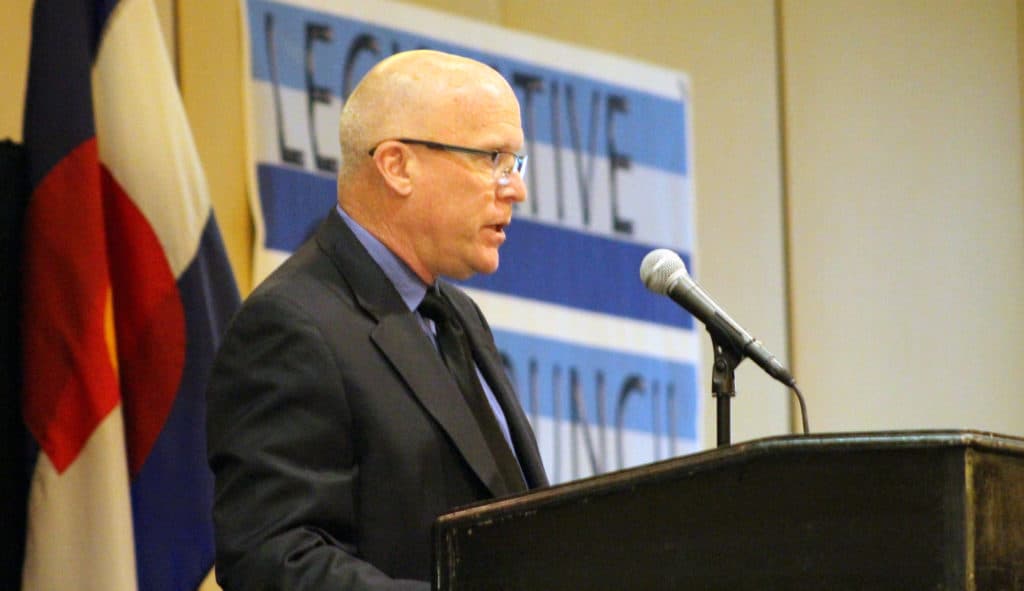
July 2010
Paul Angelico, a former school administrator and gymnastics coach who was later an assistant and associate commissioner, becomes CHSAA's eighth commissioner. He serves for seven years.
Under Angelico's guidance, the Association continued the fight for gender equity, and made specific advances for the LGBT community, including a new policy on transgender participation which was used as a model nationally.
He helped to refocus the Association on the mission of high school sports, which is to serve as an extension of the classroom. He helped to increase the promotion of high school activities by opting into the creation of the NFHS Network, and starting CHSAANow.com.
Angelico's tenure also started a long process of overhauling the classification system, which for the first time began to look at factors outside of purely school enrollment.
2011
CHSAA's Board of Control is renamed the Legislative Council. And the Executive Committee is renamed the Board of Directors.
2011
Track and field adds a fifth classification: Class 1A.
2012
Private schools are given "attendance boundaries," which are the public school district in which they reside.
2013
The bylaw recognizing the right to participation for transgender students is strengthened. It now states that CHSAA "recognizes the right of transgender student-athletes to participate ... free from unlawful discrimination based on sexual orientation."
2013
Boys lacrosse adds a second classification: Class 4A.
Summer 2013
With traditional media reducing their coverage of high school sports and activities across the state, Angelico oversees the creation of CHSAANow.com to cover and promote CHSAA activities.
"We knew that if our students were to receive the recognition they deserved, we needed to be the people to get that done," Angelico writes upon his retirement.
2015
Girls soccer adds a fourth classification: Class 2A.
2017
Girls swimming, girls golf and girls tennis each add a third classification: Class 3A.

July 2017
Rhonda Blanford-Green, a trailblazer in a number of areas, becomes the first female and first black Commissioner in CHSAA's history. Five years earlier, she became the first African-American female to lead a state association when she was hired in Nebraska.
A former standout track athlete who went on to a Hall of Fame career at the University of Nebraska, Blanford-Green was first hired at CHSAA by Ottewill in 1996. She was later Angelico's Associate Commissioner from 2010-12 before being hired by the NSAA.
Blanford-Green returned to Colorado in 2017 following Angelico's retirement, and has overseen the growth of the Association, both in terms of member schools, sports offered, but also in terms of technology.
2018
Boys soccer adds a fourth classification: Class 2A.
2018
Co-ed cheer splits into three classes: 5A, 4A and 2A/3A.
April 24, 2019
The Legislative Council approves three new sports, growing CHSAA's sanctioned list for the first time in 20 years. Unified bowling, boys volleyball and girls wrestling will begin in the 2020-21 season.
2019
Spirit adds another new division, the sixth, with the addition of game day cheer. Teams compete in 4A/5A and 2A/3A classifications.
Spring 2020
The nationwide COVID-19 pandemic causes the cancellation of the state basketball tournaments, as well as the spring season. It marks the first time since 1956 that a sport will not hold a championship game.
2020-21
Ice hockey and girls lacrosse are each set to add second classifications during the upcoming season, with the addition of a Class 4A.