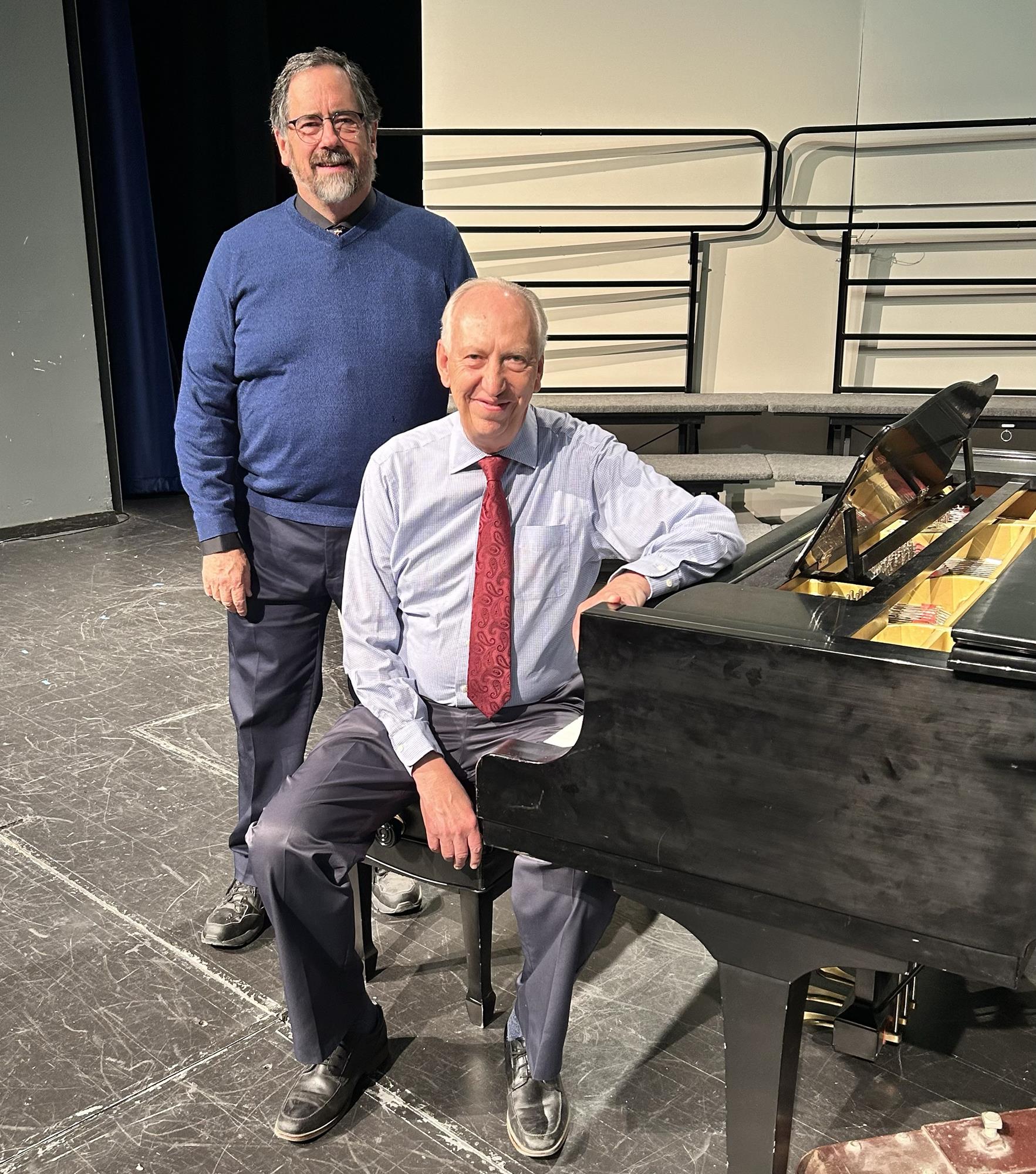
On a spring day at Doherty High School, a remarkable chapter in Colorado high school activities comes to a close. Longtime CHSAA music adjudicator Monte Atkinson is judging his final vocal music festival, exactly 40 years to the week from his very first.
Four decades. Thousands of performances. Generations of students and educators. And one enduring commitment: using music as a vehicle to uplift, educate, and inspire.
For those who have participated in CHSAA music festivals over the past 40 years, Atkinson’s presence has been both constant and transformative.
“I can’t imagine anyone who has judged or attended a CHSAA Festival who hasn’t heard of or met Monte Atkinson,” said Kevin Beaber, former music teacher and current president of the Colorado Music Adjudicators Association. “He has shared his talent, expertise and wonderfully charming personality with student musicians, choir directors and other adjudicators for generations. Few people have had the kind of influence Monte has on music-making in Colorado. While we will miss him tremendously, he will not be gone because each student, teacher and judge who has seen or heard his work carries a little part of his talent with them.”
That influence didn’t happen overnight. It was built over years of listening, teaching, learning, and, most importantly, connecting.
 A Different Era
When Atkinson reflects on his first CHSAA festival 40 years ago, the logistics alone paint a picture of a different time.
“Forty years ago, CHSAA choir and instrumental judges were shuttled around the state in a rented 15-passenger van,” Atkinson recalled. “We’d spend a week traveling from city to city, judging festivals, having dinner together, it was a shared experience. Band, choir, orchestra - we were all in it together.”
While the format has evolved, the heart of the experience remains. Students still take the stage, directors still prepare tirelessly, and adjudicators still offer a fresh perspective. But across four decades, Atkinson has witnessed subtle and significant shifts.
“The music is still fabulous, and the kids are still getting great teaching,” he said. “But the repertoire has changed. Forty years ago, we heard Mozart, Bach, Brahms - the standards. Now, we hear much more contemporary and avant-garde music. It’s a different musical experience for students.”
Participation has shifted as well.
“It seems like there are just as many students, but maybe fewer schools participating,” Atkinson noted. “Years ago, almost every school had multiple ensembles. Now, those large programs are less common.”
And yet, through all the change, one thing has remained constant.
What Endures
“Seeing a riser full of bright-eyed students, proud to be part of something meaningful, that hasn’t changed,” Atkinson said. “There’s still joy, still pride, still the sense that they’re part of something bigger than themselves.”
That sense of belonging is at the core of education-based activities, and it’s something Atkinson has worked to nurture in every adjudication.
For him, the role has never been about evaluation alone. It’s about encouragement.
“You approach it from a position of respect and gratitude,” he said. “Teachers have put in so much time preparing their students, and they’re often nervous about how their group will be received. My goal is to find what’s going well and offer a few ideas that can help them grow.”
He’s also intentional about including directors in the process.
“When I do a clinic, I always invite the teacher to stand with me,” Atkinson said. “It’s their choir. I’m just joining them. That respect matters.”
The Full Spectrum
Over 40 years, Atkinson has experienced the full range of performances, from those that move audiences to tears to those that present unexpected challenges. One moment, in particular, has stayed with him.
“It was a small school out on the plains,” he recalled. “The students came in and sang, and there was no sense of pitch. They were trying so hard, but musically, it just wasn’t there.”
Instead of focusing on what was missing, Atkinson chose to meet the students where they were.
“I spent time trying to help them hear the difference between a major and minor chord,” he said. “After 20 minutes, I realized I wasn’t getting there. But those students loved choir. They were good kids, working hard, and they cared.”
That experience became a powerful reminder.
“Not everything is polished. Not everything is high-level. But every student deserves encouragement and the chance to experience music,” he said. “Teachers across our state are doing incredible work, often in difficult circumstances.”
On the other end of the spectrum, Atkinson has witnessed performances that transcend evaluation.
“I’ve heard countless groups that just moved me to tears,” he said. “That’s the beauty of this work. You get to see it all.”
A Philosophy Shaped by Experience
Adjudicating thousands of performances has shaped Atkinson’s philosophy on music education in profound ways.
“It helped me realize that sometimes we can spend weeks perfecting something and miss the point,” he said. “It’s not just about accuracy, it’s about capturing the essence of the music.”
That perspective became central to his teaching and adjudicating.
“As adjudicators, we’re a fresh set of ears,” he said. “We hear what the audience hears for the first time. And sometimes that’s incredible, and sometimes it reveals opportunities for growth.”
For Atkinson, the ultimate goal has always been balance: striving for excellence while honoring the experience.
“Did they find the beauty? Did they find the magic?” he asked. “That’s what matters.”
Defining Excellence
When asked what makes a vocal program truly exceptional, Atkinson doesn’t hesitate.
“There are a few essential things,” he said. “First, the teacher has to know what they’re doing musically. Second, they have to love teaching and love kids. Students can feel that.”
He also emphasizes the importance of classroom culture and organization.
“The best programs are places where students want to be,” he said. “They’re not afraid, they’re engaged. And the teacher is organized, because this work is demanding.”
Those elements, when combined, create something special.
“You see programs where younger students can’t wait to join because of what they’ve seen,” Atkinson said. “That’s when you know something is working.”
Knowing When to Step Away
As he reflects on his decision to step away after 40 years, Atkinson admits it hasn’t been easy.
“I’m not sure I have a perfect answer for why I am choosing to step away now,” he said. “But I’ve always believed it’s better to step away at a high point.”
There’s also a personal component.
“My wife and I have been married 51 years,” he said. “And I realized I want to spend more time with her. That matters.”
It’s a decision rooted in both reflection and gratitude, a recognition of what has been, and what lies ahead.
A Lasting Impact
For CHSAA Assistant Commissioner Rashaan Davis, Atkinson’s legacy is clear.
“It has been an absolute pleasure to work with Monte,” Davis said. “Knowing his service to the association dates back more than 40 years speaks volumes about his passion for vocal music and his unwavering commitment to student success.
“The stories he shares, the relationships he has built, and the countless students and educators he has impacted should not be taken for granted. His contributions have helped shape generations of musicians across Colorado.
“As he adjudicates his final festival, 40 years to the week from his first, we celebrate an incredible legacy. On behalf of our office and the entire CHSAA membership, we wish Monte all the best in what comes next. His impact will be lasting.”
A Final Note
Even in retirement, Atkinson’s focus remains on the future, particularly the importance of advocating for music education.
“The ongoing challenge is making sure school leaders understand and value the arts,” he said. “We can’t do this work in isolation. It takes partnership.”
And for those who will follow in his footsteps as adjudicators, his advice is simple and powerful.
“It’s not about us,” Atkinson said. “It’s about the students and the teachers. It’s a privilege to be a fresh voice, to offer encouragement and honest feedback. That’s why we do it.”
The Final Measure
As the final notes of his last festival fade, Monte Atkinson’s impact will not.
It lives on in the voices of students who found confidence on stage. In the classrooms of teachers who grew through his insight. In the countless moments where music became something more than notes on a page.
Forty years after his first festival, the setting may be familiar, but the legacy is extraordinary.
And while one chapter ends, the harmony he helped create will continue for generations to come.